Workflow mapping: a practical guide
Most guides treat workflow mapping as an exercise in drawing a neat diagram. That is the smallest part of it, and getting it wrong is one of the quiet reasons automation projects fail.
Workflow mapping is the practice of documenting how a piece of work actually flows through your business: the real sequence of steps, the decisions, the handoffs between people, and, crucially, the exceptions and unofficial steps that the tidy version leaves out.
Done properly it is the groundwork you lay before you automate anything, not a picture you produce for a slide.
This guide is for the owner or operations lead trying to understand what workflow mapping is and why it matters, before they shortlist a tool or a provider. It is not written for the person who will draw the diagrams.
Almost every page ranking for this term exists to get you to install a particular diagramming app.
This one is tool neutral: it explains what mapping is, how to do it well, which format fits which situation, and how a good map tells you what is worth automating and what is not.
Workflow mapping sits underneath workflow automation as its first discipline. If you skip it, you automate a process nobody fully understood, which is how you end up with an expensive system that breaks the first time reality departs from the diagram.
Why this page exists at all: we build automations for UK firms, and mapping is always where we start, because we would rather find the awkward exception on a whiteboard than in production.
What is workflow mapping?
Workflow mapping is the act of recording, in a visual and shared form, every step a process passes through from trigger to completion: who does what, in what order, where decisions branch, where work is handed from one person or system to another, and what happens when something does not go to plan.
The workflow mapping definition that matters is not "a diagram of the ideal process" but "an honest record of the actual process, including its exceptions and the people who own each step."
The distinction is the whole point. A one time diagram drawn from how a manager thinks the work happens is close to useless.
A map built from how the work genuinely happens, verified with the people who do it every day, is one of the most valuable documents a business can hold.
It captures knowledge that usually lives only in one person's head, which is exactly the knowledge that walks out of the door when they leave.
In plain terms, then, the meaning of workflow mapping is discovery as much as documentation. You are not just recording a process you already understand. More often you are finding out, for the first time, what the process really is.
How does workflow mapping work?
The way workflow mapping works in practice is a short sequence of steps, and understanding it tells you why a rushed map is worse than none at all.
You start by defining the boundaries: where does this workflow begin, and where does it end? A vague scope produces a vague map. Then you gather evidence rather than assumptions.
That means sitting with the people who actually perform the work and watching or asking them walk through it, not reconstructing it from a procedure document that may be years out of date. This is the step most guides skip, and it is where the real process reveals itself.
Next you draft the happy path, the version where everything goes smoothly, because it gives you a spine to hang everything else on. But the happy path is only the beginning.
The value comes in the next step, when you capture the exceptions: what happens when a document is missing, when an approval is refused, when a customer replies with something unexpected, when the work loops back for rework.
These branches are where processes actually live and where automation most often breaks, so a map that shows only the smooth path is a map that will mislead you.
Then you validate. You take the draft back to the people who do the work and let them correct it, because the first draft is always wrong in ways only they can see.
Finally you publish it somewhere shared and, if it is going to stay useful, you give it an owner and a reason to be revisited. That last part is what separates a living map from a diagram that quietly goes stale on a drive.
This whole workflow mapping tutorial in miniature comes down to one idea: gather the truth, draw the truth, check the truth, and keep it true.
The levels of a process: L1 to L4
One thing that trips people up is that a workflow can be mapped at very different depths, and mixing them produces a confusing map. It helps to think in levels.
A level one view is the high altitude picture: the handful of major stages a process passes through, the kind of thing that fits on a single line. Level two breaks each of those stages into its constituent sub processes.
Level three shows the actual step by step activities a person or system performs within a sub process, and level four goes down to the detailed work instructions, the individual clicks and rules.
You do not map everything at level four; that way lies a wall of detail nobody reads. The skill is matching the level to the purpose. If you are trying to understand where a process fits in the business, map it at level one or two.
If you are preparing to automate a specific task, you need level three, and sometimes level four for the part being automated, because that is the depth at which the exceptions and decision rules become visible.
Deciding which level you need before you start is one of the simplest ways to avoid a map that is either too shallow to be useful or too detailed to finish.
Flowchart, swimlane or BPMN: which format to use
The format question is where tool marketing muddies the water, so here is a clean decision rule.
A flowchart is the right choice when the process is simple and lives within a single team. It shows steps and decision points in sequence and nothing more, which is exactly what you want when nobody is being handed work and no accountability is in question.
Do not reach for anything heavier than this unless the process demands it.
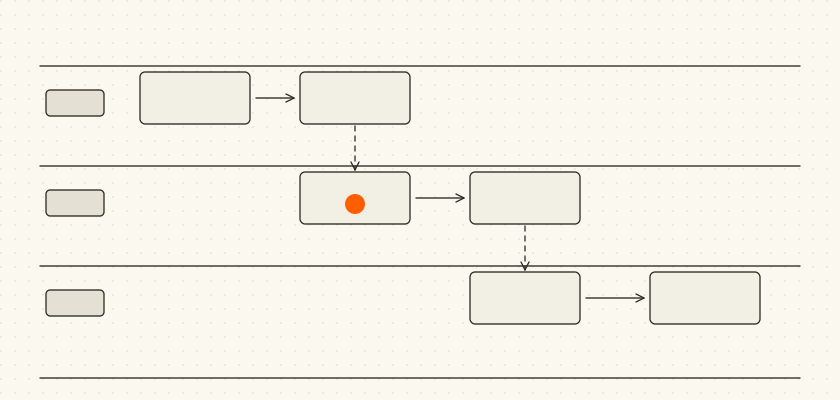
A swimlane diagram is the right choice the moment a process crosses more than one person, team or system. Each "lane" belongs to one actor, and the map shows work moving between lanes at every handoff.
This is powerful because handoffs are where most delay, confusion and dropped work happen, and a swimlane makes them impossible to hide. When your problem is "who owns what and where does it stall," a swimlane is the format that answers it.
Business Process Model and Notation, or BPMN, is the right choice when a process is governance heavy or compliance sensitive, or when it branches in complex ways that a simple flowchart cannot express precisely.
BPMN is a formal standard, maintained by the Object Management Group, with a defined vocabulary for events, gateways and message flows, so it removes ambiguity where ambiguity would be dangerous.
The cost is that it takes more skill to read and write, which is why it is overkill for a two step internal task.
You can draw any of these in general tools such as Lucidchart, Miro or the free draw.io; the tool matters far less than choosing the right format and capturing the truth in it.
Workflow mapping in practice: three worked examples
The strongest workflow mapping examples are the ones that expose steps nobody knew were there. Here is a concrete UK one from the kind of work we do.
A lettings agency wanted to speed up how it moved a new tenant from accepted offer to move in day. On paper the process was clean: offer accepted, referencing done, tenancy agreement signed, deposit registered, keys handed over.
When we mapped it as a swimlane across the three teams involved, the lettings negotiator, the referencing administrator, and accounts, the real process turned out to be nothing like the diagram in the office manual.
There was an unofficial spreadsheet the referencing administrator checked before starting, because the CRM did not show whether a guarantor was needed. There was a chasing email that got sent, or forgotten, depending on who was covering.
There was a point where accounts waited on a document that lettings assumed referencing had already sent. None of those steps existed officially, and all of them caused delay.
That is the use case that matters. The map did not just describe the process; it revealed why move ins were slipping, and it showed exactly which steps were candidates for automation and which needed a human decision. Other common use cases run the same way.
Mapping a client onboarding workflow across sales, admin and finance shows where a new client stalls between departments. Mapping a support escalation shows where a ticket sits waiting for an owner. Mapping an invoice approval shows the informal "just check with Dave" step that no system enforces.
In every case, workflow mapping for business is less about the picture and more about the hidden truth the picture forces into the open.
Benefits of workflow mapping
The benefits of workflow mapping follow directly from that. The first is shared understanding: a process that lived in fragments across several people's heads becomes a single thing everyone can see and agree on.
The second is that it surfaces waste and risk you could not otherwise name, the redundant approval, the step that exists only because it always has, the single person on whom an entire workflow silently depends.
The third benefit is resilience. A documented process survives the departure of the person who used to run it in their head, which for a small business is often the difference between a smooth handover and a crisis.
And the fourth, the one this cluster cares about most, is that a good map is the only reliable basis for automation. You cannot safely hand a process to software until you can see it whole, exceptions included.
The map is what makes the difference between automating the work and automating a guess.
From map to automation: scoring what is worth it
A map is not an end in itself. Once you can see the process clearly, the next question is which parts of it are worth automating, and a good map lets you answer it honestly rather than optimistically.
The candidates that pay off share a profile. They are high volume, so the time saved is real. They are rules based at the point of decision, or close to it, so software can make the call reliably.
They have clear handoffs, which a swimlane will already have exposed. And they have a low exception rate, or exceptions that are themselves predictable, because a process that branches unpredictably at every step is one that will need a person no matter what tool you buy.
Scoring each mapped step against that profile turns a diagram into a shortlist.
This is where mapping hands off to the rest of the discipline.
Working out whether a shortlisted step genuinely needs AI or just plain rules is the subject of AI workflow automation explained, and the wider sequence of doing automation well, mapping included, is covered in our guide to process automation best practices.
Map first, score honestly, then automate the parts that earn it. That order is the whole game.
Workflow mapping FAQ
Turning a mapped workflow into an automated one
If you are mapping a process because you suspect part of it could be automated, the map is the beginning, not the answer.
The honest next step is to work out which mapped step is genuinely worth putting on rails, whether it needs AI or just plain rules, and how it connects to the systems you already run.
That is what an automation audit is for: we walk the mapped process with you, mark the steps that earn automation and the ones that do not, and where a build makes sense we shape it around your current stack.
If a build is the right call, we deliver and look after it through our workflow agents service.
A map on its own changes nothing. An automation audit takes the process you have mapped and tells you which part is worth putting on rails.