The complete workflow automation guide
Workflow automation is the use of software to run a business process from start to finish with little or no manual effort.
Instead of a person moving each task along by hand, a system watches for a trigger, follows the rules you set, and carries out the actions: updating a record, sending an email, creating an invoice, notifying the right person. The work still happens. It just stops needing someone to shepherd it through every step.
Somewhere in your business right now, someone is copying figures from one screen into another, or chasing a document that should have arrived on its own. Workflow automation is simply the practice of handing that repetitive, rules based work to software so it runs reliably without anyone minding it.
This page is for the owner or operations lead deciding whether that is worth doing, not the person who will build it: what the work looks like in a real UK business, the shapes it comes in, the tasks it genuinely takes off your plate, and what it costs to set up and keep running.
One note on where we sit, so you can weigh what follows. Sizrok builds and maintains bespoke automations around the tools a business already runs.
That gives us a strong view, but it also means we have a stake, so this guide names honestly when a template tool or a platform is the better answer than a custom build.
Every other page ranking for this term is published by a software vendor selling you their product. We think the honest version serves you better.
What is workflow automation?
Workflow automation is technology that performs a sequence of tasks automatically, following defined rules, to complete a business process without a person driving each step.
A workflow is simply the series of steps that gets a job done, from a new lead landing in your inbox to that lead sitting correctly in your CRM. Automation is having software do those steps for you.
Put the two together and you have a process that runs itself, consistently, every time, without anyone copying data or chasing the next action.
It helps to separate the two words. A workflow is the path work takes through your business. Automation is the engine that moves it.
The reason the phrase matters is that most time lost in a business is not lost to the hard, valuable work. It is lost to the connective tissue between systems: the retyping, the forwarding, the "did anyone update the spreadsheet" moments. Workflow automation targets exactly that connective tissue.
This sits inside the broader discipline of business process automation, which covers automating whole end to end processes rather than single tasks. Workflow automation is the practical, everyday face of it: the specific flows you can put on rails this quarter.
How does workflow automation work?
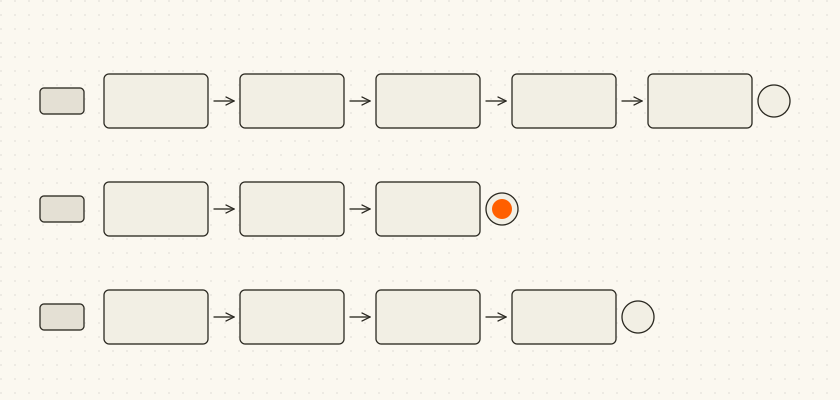
Almost every automation, whatever tool builds it, follows the same three part shape.
A trigger starts it. Something happens that the system is watching for: a form is submitted, an email arrives, a deal is marked won, a date is reached. That event kicks off the flow.
Rules decide what happens next. These are the conditions you define. If the invoice is under a threshold, approve it automatically.
If it is over, route it to a manager. The rules are the logic of your process, written down once so the system applies it the same way every time.
Actions carry out the work. The system does the thing: creates the record, sends the message, moves the file, updates the dashboard. One trigger can fan out into many actions across several systems that would otherwise never talk to each other.
So a simple onboarding flow might run like this. A new client signs the contract (trigger).
The system checks which service they bought (rule) and then creates their CRM record, raises the first invoice in your finance tool, adds them to the right onboarding email sequence, and posts a note in your team channel (actions).
What used to be twenty minutes of careful copying becomes something that happens in seconds, the same way, without anyone forgetting a step.
That is the classic rules based model, and it is powerful for predictable processes. Where the path is fixed, it is fast, cheap and reliable. Its limit is that it only does what it was explicitly told, so an input it did not expect stops it.
That is where AI changes the picture, letting a workflow interpret messy inputs and decide rather than just follow. We unpack that shift in AI workflow automation explained, because it is becoming the more important half of this topic.
Types of workflow automation
It is worth knowing the main distinctions, because they change what a process can handle.
The first split is rules based versus AI driven. Rules based automation follows fixed logic and suits stable, predictable processes.
AI driven automation uses a model to interpret unstructured inputs, such as the free text of an email or the contents of a document, and to make judgement calls the rules could not anticipate.
Most real businesses end up with a mix: rules for the predictable spine of a process, AI for the messy edges.
The second useful distinction is by scope. Task automation handles a single repetitive action, such as sending a reminder. Process automation strings many tasks into a complete workflow, such as the full onboarding above.
Decision automation adds a judgement step, where the system weighs conditions and chooses a path rather than following one. You will also hear about robotic process automation, or RPA, which mimics a person clicking through screens, and business process automation, the broader umbrella over all of it.
If a term trips you up, our automation glossary keeps plain English definitions in one place.
Which type fits depends entirely on the job in front of you, which is why matching the process to the right approach matters more than picking a fashionable tool. Our guide to automation best practices goes deeper on getting that match right.
Workflow automation examples and use cases
The useful question is not what automation can do in theory, but where it earns its keep in a real business. In practice the strongest candidates are high volume, rules heavy work that drains time without needing much judgement. A few that come up again and again:
Sales and CRM: capturing new leads, enriching them, logging activity, chasing follow ups, and keeping the pipeline tidy so salespeople sell rather than type. Finance: matching invoices to purchase orders, routing approvals, flagging anomalies, and prepping month end. Human resources: onboarding checklists, document collection, answering routine policy questions.
Customer support: triaging incoming tickets, routing them to the right person, and drafting first replies. Operations: moving data between systems that do not integrate, generating routine documents, and syncing records so two tools stop disagreeing.
Here is a concrete UK example from the kind of work we do. An online retailer was reconciling orders by hand every morning, pulling figures from the shop platform, the courier portal and the accounting package, then hunting for the ones that did not match.
It ate the first hour of someone's day, and mistakes still slipped through. Now a workflow pulls all three sources overnight, matches them automatically, and surfaces only the genuine discrepancies for a person to resolve. Nothing about it is exotic.
The change is that a tedious daily reconciliation stopped being a person's job and became a short exception list instead.
A word on honesty, because it serves you better than the excited version. Not every process should be automated. Where work needs professional judgement, a relationship, accountability or real creativity, such as advising a client or closing a complex deal, automation is a support tool at best.
The businesses that win are ruthless about pointing automation at the boring, repeatable middle of their operations and keeping people on the parts that actually need a person.
Benefits of workflow automation
Stated plainly, and with sourcing rather than the round numbers the vendor blogs recycle, the benefits come down to a few durable things.
Time back. The repetitive admin that fills a working week gets absorbed, freeing people for work that needs a human.
The scale of the opportunity is large: McKinsey's analysis found that about half of the activities people are paid to do could be automated by adapting currently demonstrated technology, a share that has only grown as AI has matured.
Few businesses will automate anywhere near all of it, but even a fraction is meaningful.
Fewer errors. A system that follows the same rules every time does not mistype a figure or forget a step at half past five on a Friday. For processes where a small mistake is expensive, such as finance or compliance, that consistency is often worth more than the time saved.
Consistent, around the clock execution. Automated workflows run at 3am and during your busiest week alike, without queues building up because one person was on leave.
Scale without proportional headcount. When volume rises, an automated process absorbs more of it without you hiring in step. Growth stops being throttled by how fast you can add people to the admin.
For context on the UK specifically, the Office for National Statistics found that around a quarter of UK businesses were using some form of AI by late 2025, rising to roughly 44 percent among firms with 250 or more staff.
Adoption is no longer early, but there is a clear gap between large firms and smaller ones, which is precisely the gap a well chosen automation can help a smaller business close. Treat headline return on investment figures with care though.
The gains are real for well scoped processes and thin to negative for rushed ones. The variable is rarely the technology. It is the discipline of what you choose to automate.
Off the shelf versus platform versus bespoke
This is the decision no vendor guide will help you with, because each one is selling a particular answer. Here is the neutral version.
Buy off the shelf when your need is common and self contained, such as an email marketing tool or a scheduling app with automation built in. It is quick and cheap to start, and for a standard need it is the right call.
The limit is that it lives in its own silo and rarely bends to the specific way your business runs.
Adopt a platform, meaning a no code or low code tool such as the well known connectors, when you want to wire several apps together yourself and you have someone in house with the time and aptitude to build and maintain the flows. You get real flexibility.
You also own the build, the upkeep, and the integration headaches, and those headaches are where a lot of internally built automation quietly stalls once the person who built it moves on.
Have it built bespoke when the value is in connecting the specific systems you already run and automating a process particular to your business.
No vendor page describes this option, yet it is where a lot of established SMEs land, because the honest version of their problem is rarely "I need an automation tool." It is "I need my existing systems to behave like one, without someone stitching them together by hand."
A simple rule of thumb: if an off the shelf tool already does exactly what you need, buy it and keep things simple.
But if the value sits in the glue between the systems you already run, something built around that stack will outperform any generic product, because the generic product has no way to know how you actually work.
Shaping and running that kind of build is what we do at Sizrok, though the principle stands whoever you pick.
What does workflow automation cost?
Nobody selling a tool wants to quote a number here, partly because an honest one depends entirely on your setup. So rather than a price, here is the shape of the cost, which is enough to size your own case realistically.
There are two parts. The first is the upfront work of setting it up: the design and integration effort, which grows with the number of systems involved and the complexity of the logic. A single flow bolted onto a tool you already pay for is cheap.
A process that spans five systems with branching decisions is a proper project. The second is what it costs to keep running, meaning any subscriptions, the compute for any AI in the loop, and the upkeep as your tools change around it.
What moves the figure is the number of systems connected, the volume of work each month, how much of it needs AI level interpretation rather than plain rules, and how much oversight and logging you insist on.
A well scoped automation aimed at a genuinely high volume process usually earns back its cost in freed staff time, provided it is aimed at the right process in the first place.
There is no shortcut to a real number except scoping your actual workflow, which is what an audit does.
How to map and start automating
The single biggest predictor of whether an automation delivers is not the tool you pick. It is whether you understood the process before you automated it. Automate a broken process and you simply get a faster broken process. A sensible sequence looks like this.
Map the real workflow first. Write down what actually happens today, including the exceptions and the "and then Sarah checks it" steps, because most of the value and most of the risk hide in the exceptions.
This step matters enough that we have written a separate guide to workflow mapping to do it properly.
Begin with one repetitive, low stakes process rather than automating everything at once. Somewhere a slip is easily undone. Prove the approach there, then widen it.
Choose the approach honestly. Using the off the shelf versus platform versus bespoke framework above, be clear eyed about whether a template tool covers it or whether the value is in the integration.
Build in oversight from the start. That means a record of what ran, a human sign off before anything consequential, and a straightforward way to pause or reverse the flow.
It is also the answer to the governance and data question, which is a fair one to ask before you let software act on your records.
Measure against how things worked before, whether that is hours returned, error rates, or how much moves through in a week. A change you cannot measure is one you cannot prove.
Automation is also shifting from fixed rules toward systems that reason and adapt. If you are thinking about where this is heading, our complete guide to AI agents covers the next step beyond rules based flows, where a workflow can handle the exceptions rather than break on them.
For the everyday version of this, our work on reducing repetitive admin is where mapping and automation come together for a UK business.
Common workflow automation questions
Starting your first workflow automation
If you are weighing this up for your own business, the honest first move is not picking a tool. It is deciding which of your processes actually deserves automating and how it ties into what you already run.
That is what an automation audit is for: we walk your process, say plainly whether automation fits and which approach makes sense, and where a build is justified we shape it around your current stack instead of bolting on something new to learn.
If that is the route, our workflow agents service is where we build it and keep it running.
Not sure which of your processes is worth putting on rails? Start with an automation audit and we will scope it with you.