Inbound receptionist
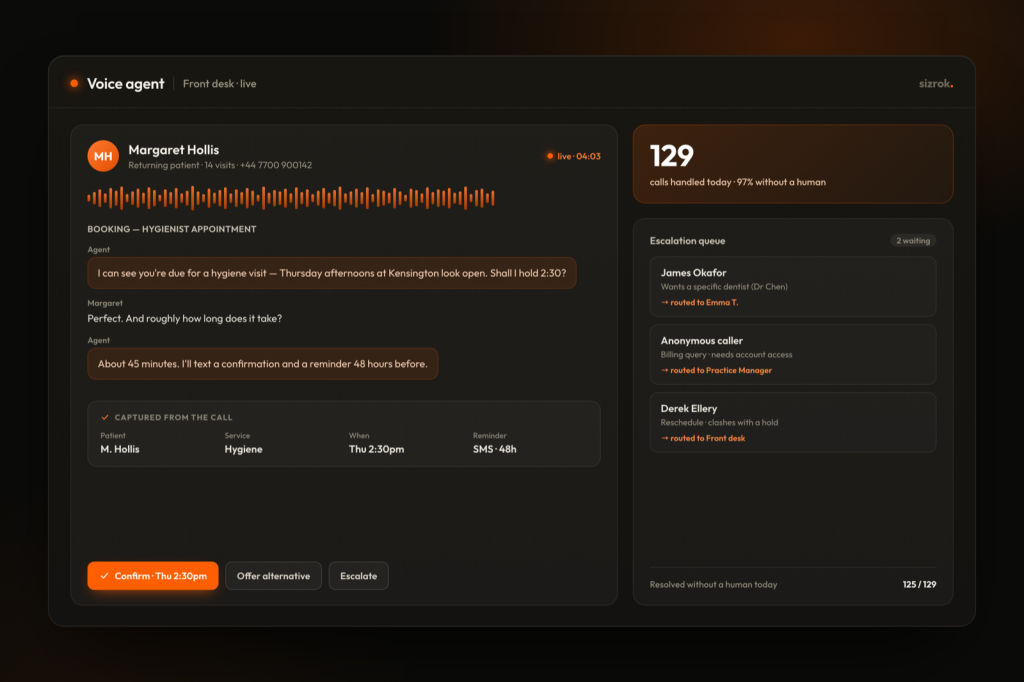
An independent dental group with three city locations came to us with a version of the same problem every multi site practice has. Calls coming in while the desk was with a patient. Evening enquiries that waited until the next working day. Busy line drop offs that nobody ever knew about, because the caller was already gone before anyone could call them back.
The brief was straightforward. Answer every call, on every channel, every hour of the day. Book the ones that can be booked without needing a person free. Surface the ones that need a human with the context already gathered. Below: where the revenue was slipping, what we put in place, and what the first month looked like in production.
The situation
The group ran three locations across different parts of the city, each with its own desk team and its own habits. One site had strong coverage during core hours and a dead phone after five. Another had a reliable morning shift and an afternoon gap whenever someone was on leave. The web chat existed on all three sites but was effectively unmanned after close of business.
Where the calls were going
We looked at the call data before we designed anything. The pattern held across all three sites. A morning rush that regularly went past the desk’s capacity, an out of hours window that collected unanswered calls from six in the evening to nine the next morning, and a busy line overflow that was impossible to measure because the callers simply hung up and, often, booked somewhere else.
New patient registrations were the most common casualty. An existing patient with an appointment query will call back. A new patient looking for a practice who hits voicemail at seven in the evening usually does not.
What the calls were about
We listened to a sample of the recorded calls before writing a line of the agent. The vast majority were operational. Request a new appointment, move an existing one, ask about a treatment, confirm an address or parking. These are not complex requests. They are high volume, time sensitive and repeatable, exactly the shape of work a well configured voice agent handles cleanly.
A smaller number needed clinical context. A question about symptoms after a procedure, a concern about a medication interaction, something better spoken to a dentist or nurse about. Those were never going to be answerable by the agent, and the design had to make sure they reached a person quickly, without the patient having to explain everything twice.
The desk was not slow because the team was slow. Calls were being lost because there was no one free at the exact moment they arrived. In dentistry, the gap between an unanswered call and a patient booked elsewhere can be measured in days.
What we built
We built a voice agent that sits in front of all inbound calls across the three locations. It answers on the first ring, greets the caller in the practice’s own voice, and handles the call from there. It reads live availability, books the appointment in real time, takes a deposit over the phone where one is due, and sends the confirmation before the call ends.
It works through the systems the practice already runs on. It reads and writes live availability in their Dentally book, and takes deposits through Stripe, the processor they already use at the desk. The booking is a real booking in the same system the team opens every morning, not a message for someone to action later.
Connected to the booking system from day one
The agent does not take a message and wait for a human to call back. When a patient asks for an appointment, it reads the actual open slots in Dentally, offers the ones that fit, and makes the booking while the caller is still on the line. The confirmation goes to the patient’s phone or email, whichever they prefer, before they hang up.
For existing patients moving an appointment, the agent pulls their details and handles the change without them having to spell out their name, date of birth and reason for calling to a human first.
Deposits collected on the call
New patient registrations include an optional deposit step. The agent takes it directly through Stripe, so a new patient can register, book and pay in a single call. No callback. No link sent later that never gets clicked. The booking is confirmed and the deposit secured before the conversation ends.
The agent does not attempt clinical triage. In a dental setting the cost of a confident wrong answer is far higher than the cost of an extra handover. The moment a call moves towards anything clinical, symptoms, concerns after a procedure, medication questions, the agent stops trying to help and starts trying to connect the patient to a person. That boundary was the most carefully designed part of the build.
How a call flows
A patient calls the main number. The agent answers at once, identifies the location they are calling for, and asks how it can help. For a new appointment, it asks for availability preferences, reads Dentally, and offers slots. The patient picks one, the agent confirms it, collects any details needed, takes a deposit if one is due, and sends the confirmation. Average handle time in production: 1 minute 42 seconds.
The careful path
If a caller sounds distressed, mentions a clinical concern, or asks a question the agent is not scoped to answer, the tone shifts. The agent tells the caller plainly that it is connecting them to a member of the team, and routes the call with a short summary already queued for the person picking up. The staff member arrives knowing who is calling and why, rather than opening cold.
Escalations are logged with their trigger, so the practice manager can review what is reaching a human and whether the scope of the agent sits in the right place. When a particular question keeps escalating without needing to, that is a signal to widen the agent’s remit, in writing, on purpose, rather than by drift.
What the first month looked like
1,847 inbound calls handled in the first thirty days across the three locations. Average handle time 1 minute 42 seconds, down from a previous average of 2 minutes 58 seconds when calls were reaching the desk. Missed call rate across the practice: 4.1 percent.
Booking rate: 73.4 percent of the calls that reached the agent ended in a booked appointment. That includes the out of hours calls that would have gone unanswered and the busy line overflow that would have been lost.
Revenue captured in month one
The practice tracks the revenue from calls that would not have been answered without the agent.
- £23,940 from out of hours bookings, calls outside core desk hours
- £14,480 from busy line overflow, calls that came in while the desk was occupied
- £12,650 from deposits taken on the call at registration
- £7,840 from missed call recovery, patients who had called before and not been reached, followed up by the agent
- £4,200 from no show prevention, reminders that cut cancellations which used to go unfilled
Total: £63,110 in month one.
Where it goes next
The agent ships operable, not finished. Every prompt, the routing rules and the escalation triggers sit in the group’s own account, and the practice manager has already made her first edit to the wording without us in the room. That was the moment the dependency broke.
The obvious next step is to widen the routine remit as trust grows. A few more request types that currently escalate but could be handled safely, and a view of the contact logs that lets the practice get ahead of the questions patients keep asking. None of that is committed yet. The agent does its current job well, and the group will widen it when they are ready, on their own terms.