Sales pipeline agent
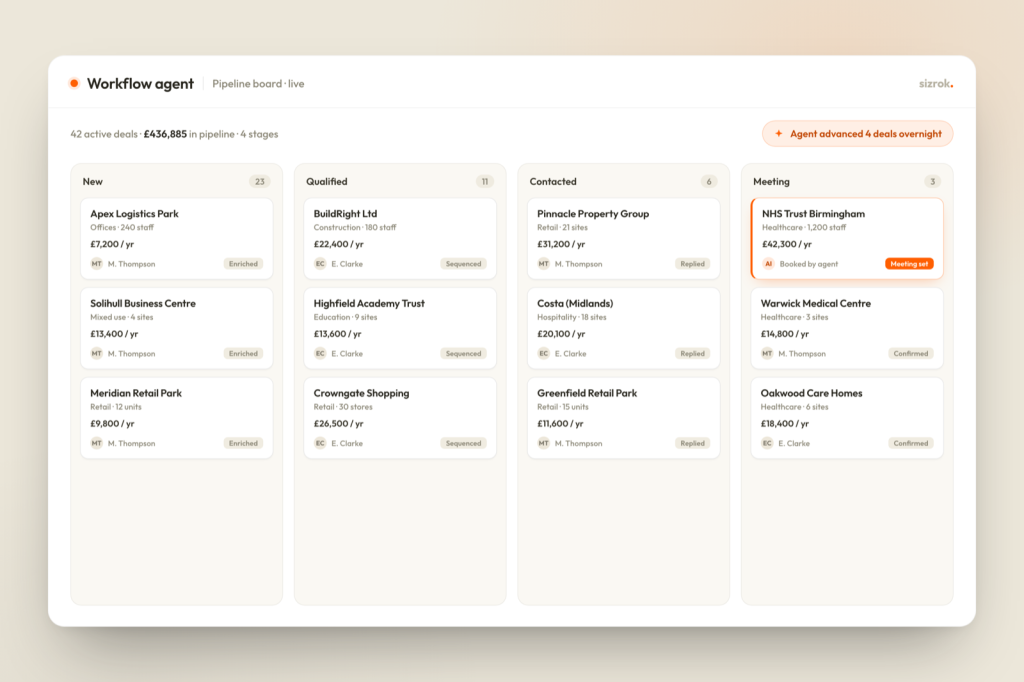
A commercial cleaning company working across five verticals, offices, retail and hospitality, construction, healthcare and education, came to us with a pipeline problem. The business was winning work, but the leads were moving only as fast as someone remembered to push them. Three salespeople were spending a third of their time on follow up administration, and a steady share of good prospects were quietly expiring in a spreadsheet nobody fully trusted.
This is an account of what we built, how it runs, and what changed in the first month in production. The headline: 847 leads processed, 94 meetings booked, 31 deals won at an average value of just over nine thousand pounds. Below: where the pipeline was leaking, what we put in place, and what moved once it went live.
The situation
The company had a CRM it did not fully use and a spreadsheet it used instead. Every inbound lead landed in a shared inbox, got entered by hand by whoever had time, and sat there until a salesperson got to it. There was no qualification stage, no scoring, and no automated follow up. A lead worth three hundred pounds and a lead worth thirty thousand got the same manual attention, in the same order, from the same person.
Where the time went
We mapped the week before we built anything. A lead arrives. Someone reads it, decides whether to call, looks up the location, checks the sector, estimates the contract size, and writes a follow up message. If the prospect does not respond, the same steps repeat three days later, again at a week, and then the lead enters a mental to do list that empties itself whenever the team gets busy. Competitor activity got noted wherever there was room, which meant it mostly did not get noted at all.
None of that is skilled work. It is attentive, repetitive work, and it was happening at the same pace whether the lead deserved the attention or not.
The salespeople were not closing more deals because they were spending their selling time on the administration around selling. The pipeline was not growing. It was surviving.
What we built
We built a sales pipeline agent that sits behind every inbound lead and every active deal. It enriches, qualifies, scores, monitors and sequences without anyone telling it to. The salesperson sees a lead arrive with the research already done, scored, and already in motion.
It runs on the tools the company already pays for. It reads new enquiries from the shared inbox, writes every lead and every update straight into their HubSpot CRM, books meetings into the team’s calendar, and works from the recordings the phone system already makes. Nothing new to log into. The reps keep working where they already worked.
The five things the agent does
Lead enrichment runs the moment a lead lands. Sector, site profile, estimated contract value, and a read of the competitive picture for that area. Lead qualification scores the lead against the company’s own criteria and routes it straight to a rep or into a nurturing sequence. Deal scoring updates as a prospect moves through the pipeline, so the team always knows which open deals are worth more attention this week and which will close without it.
Call transcription and actioning takes the recording of every sales call, writes a plain summary of what was agreed, and creates the follow up tasks in HubSpot. Re engagement sequences find the cold prospects, the ones who went quiet after a solid first conversation, and put them back in front of the right person at the right interval, without anyone having to remember they existed.
We kept the agent out of the closing conversation. It enriches, qualifies, scores and sequences. The moment a rep is talking live to a real prospect, the agent steps back. Closing is not a process to automate. The agent’s job is to make sure the rep spends more time doing it.
How a lead moves
An enquiry comes in. The agent reads it, runs the enrichment, checks the sector and location against the company’s win history, and assigns a score. Above the threshold, it surfaces the lead to a rep with a brief. Below it, the lead enters a qualifying sequence that runs on its own until the prospect engages or disqualifies cleanly.
From enquiry to meeting
The qualifying sequence does what a diligent rep would do with the time to do it consistently. A first message on the day the lead arrives, a follow up at three days, a second at seven with a different angle, and a closing note that leaves the door open. If the prospect responds at any point, the sequence stops and the conversation is handed to a rep with a full log of what was sent and what was said. The rep steps in already in the picture rather than starting cold.
The lead does not wait for someone to find it in the spreadsheet. It goes into motion the moment it lands.
What changed
In the first month in production: 847 inbound leads processed, 68.3 percent qualified and moved forward, 94 meetings booked. Thirty one deals won at an average value of just over nine thousand pounds each, with a total tracked pipeline of two hundred and eighty four thousand pounds.
The figures are the straightforward part to state. The quieter change is in how the team works. The three salespeople stopped spending a third of their time on follow up administration and started spending it on calls and site visits. Leads that used to die quietly in the spreadsheet now either advance or disqualify cleanly. The pipeline view the management team opens each morning is accurate rather than approximate.
The competitor picture
An unexpected benefit was the market visibility. The agent watches competitor activity across the company’s operating areas and logs signals from call transcripts and public sources against the relevant deals and verticals. Before, that lived in individual salespeople’s heads and was lost whenever someone had a heavy week. Now it accumulates in HubSpot alongside the deals and informs how the team positions against each competitor, by sector, in real time.
Where it goes next
The agent does its current job well and the team now owns the configuration. The natural extensions are theirs to take. Tighter scoring rules as the win data builds, sector specific sequences for healthcare and education leads, and a view of which sequences convert and which do not.
None of that needs us. The handover was done on day one. The repository, the prompts, the credentials, all transferred the day it went live. The system keeps getting better in hands that are not ours, which is the measure of whether the build was done right.