AI for recruitment agencies
Most AI built for recruiters automates the shortlist and stops, as if screening were the whole job. The purpose built tools parse CVs, score them against a brief and rank the field, and they do that part well. But a consultant's desk is not mostly screening.
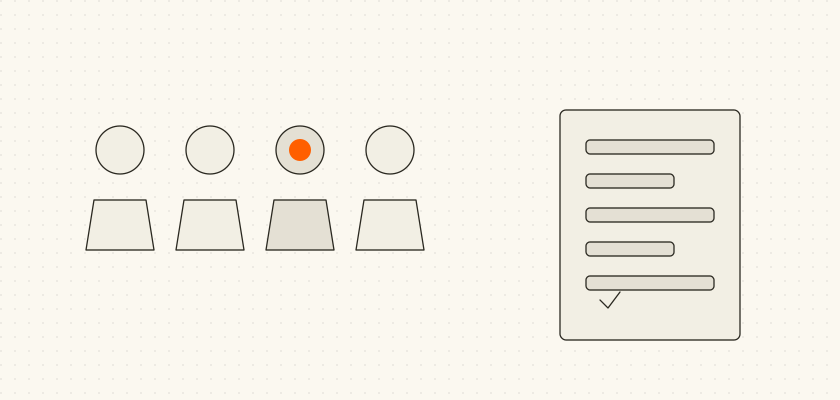
It is business development and lead research, writing spec CVs and job ads, keeping candidate and client conversations moving, chasing timesheets and compliance documents, and grinding through placement and onboarding admin.
The screening tools take the one task that was already quick and leave the rest of the desk exactly as it was. Meanwhile they ask you to adopt their ATS or bolt onto it, when the stack you already run is the one thing you should not have to change.
That is the gap this page is about. Your consultants lose hours a day to CV review, comms chasing and admin instead of billing, and the software sold to fix it forces a platform and only touches the shortlist.
Sizrok builds bespoke AI automation for UK recruitment agencies, wrapped around the ATS and CRM you already run, whether that is Bullhorn, Vincere, JobAdder, RecruitCRM or Access, and covering the whole desk rather than one step of it.
We build it to the UK rules that matter: screening as decision support that surfaces candidates for a consultant to review, never an automated reject gate. Book a discovery call and we will start with where the desk time is actually going.
Tell us where the time is going.
What AI can actually do for recruitment agencies
In plain terms, AI for recruitment agencies is the use of language models and automation to take on the sourcing, screening, comms and compliance admin that fill a consultant's day, so more of the week goes to relationships and placements and less to the desk work around them.
It does not make the hire, own the client relationship or decide who to reject. It surfaces, drafts, chases and tracks so the consultant can decide faster and with better information.
The AI use cases for recruitment agencies that repay the effort run across the whole desk. Parsing and scoring CVs against a role brief as decision support, not an auto reject. Sourcing candidates across boards, networks and your own database.
Drafting job ads and spec CVs in your house style. Keeping candidate and client comms on cadence so nothing goes cold. Scheduling interviews.
Chasing timesheets, references and compliance documents. Researching business development leads. Handling placement and onboarding admin.
In each case the routine sourcing, drafting and chasing is machine made and the judgement about a person is not. If you want to see how these are put together, our guide to AI agents and our AI integrations guide set out the underlying machinery.
When we talk about generative AI for recruitment agencies here, we mean drafting ads, spec CVs and message drafts, not deciding a shortlist or issuing a rejection, which stays with the consultant.
The recruitment workflows we build
It helps to lay the work out by the stage of the desk it belongs to. A recruitment agency is really several jobs at once, sourcing, selling, communicating and staying compliant, and each of them generates its own routine.
Which one we build first is settled by where your consultants are losing the most billing time.
Sourcing and screening is the first stage: parsing incoming CVs, scoring them against the brief as a ranked longlist for a consultant to review, and mining your existing database for people you already know.
The gathering and ranking automate cleanly; the decision on who to put forward stays with the consultant.
Business development is the second, and the one the screening tools ignore entirely: researching leads, spotting hiring signals, drafting spec CVs and keeping an outreach cadence running so the pipeline does not depend on whoever remembered to follow up. This is billing work that admin usually crowds out.
Candidate and client comms is the third: nurturing both sides, scheduling interviews, and chasing feedback so conversations do not stall. Repetitive, time sensitive contact that suits automation a consultant oversees.
Compliance and admin is the fourth: Right to Work prompts, timesheet and reference chasing, and placement and onboarding paperwork. Deadline bound, document heavy work that quietly absorbs a consultant's week.
Many of these are not particular to recruitment, and we handle them across other service businesses too. If a specific one is yours, our guides to reducing repetitive admin, AI email automation, AI enquiry handling and eliminating manual data entry cover each in detail.
Other professional service firms shoulder much the same admin, and the same approach runs on our work for marketing agencies, accountants and legal firms.
Why bespoke and ATS agnostic beats a fixed tool
When the admin starts eating the billing, the obvious move is to adopt one of the recruitment AI products or a screening bolt on. For scoring CVs it can be good. For a whole desk it fits poorly, and the reasons are worth spelling out.
A fixed tool does one job and asks you to work its way. You take on its ATS or plug into it, learn its interface, pay a per user seat for every consultant, and get automation for the shortlist while sourcing, BD, comms and compliance carry on by hand.
A bespoke build takes the opposite route. It stays with the ATS and CRM you already run, automates the specific desk workflows that are costing you, and leaves your data and your desks where they are.
You get the whole desk covered, not just the step that was already fast, without a migration and without a seat count that climbs with every hire.
There is a compliance point underneath this too, and it is not cosmetic: candidate data and hiring decisions are governed, so any automation touching them has to be auditable and keep a human in the loop, not a black box that quietly filters people out.
There is a boundary here that deserves to be said out loud. Can AI replace recruitment agencies?
No. The relationships, the read on whether a person will fit a team, the negotiation and the care that wins a candidate and keeps a client are exactly what does not and should not automate.
What automates is the sourcing, the screening prep, the chasing and the admin around those judgements. Done well, AI does not shrink the consultant's role; it clears the desk work so more of the week goes to billing.
That is the whole reason the build fits around your ATS, your desks and your margins instead of arriving as a product you have to reshape your agency around.
Built for UK recruitment compliance
What separates this from the tool lists and productivity claims is that it is built for the rules a UK agency actually recruits under.
That means screening treated as decision support, with a consultant reviewing the longlist rather than a model auto rejecting anyone, in line with the solely automated decision rules in UK data protection law.
Those rules changed recently: Section 80 of the Data (Use and Access) Act 2025 replaced Article 22 of the UK GDPR with new provisions that took effect on 5 February 2026, moving to a safeguard led approach that still requires transparency, human review and a right to challenge.
On 31 March 2026 the ICO published guidance and a recruitment specific report warning that many employers believed they were using tools as decision support when, in practice, there was no meaningful human involvement (the ICO on automated decisions in hiring sets out what it expects).
That is precisely the line we build to, alongside EHRC guidance on avoiding bias and Right to Work obligations.
We work with agencies from London, Manchester and Birmingham to desks in Bristol, Leeds, Glasgow, Edinburgh and Cardiff, and every build is grounded in UK recruitment practice rather than lifted from an overseas vendor. Our nationwide approach is laid out in UK AI automation agency.
What AI for recruitment agencies costs
The recruitment tools quote a per user seat and leave it there, so we will be straight about how a bespoke build is priced even though the number moves with the work.
The drivers are the count of desk workflows in scope, how many systems and boards each one has to reach into, how bespoke your process and margins are, and how much data moves between the tools.
A single, contained workflow, CV parsing into a scored longlist, for instance, is a small build; a programme across sourcing, BD outreach, comms cadence and compliance chasing is a larger one.
A price on the page would be wrong for almost every agency, so we agree and hold it at discovery, once the actual desk workflow is in view, and upkeep is a flat retainer after that.
Weigh it against the consultant hours currently lost to CV review and chasing, and against the placements those hours could have made instead: for most agencies a handful of reclaimed billing days more than covers the build.
And where the numbers do not support it, we say so rather than sell you a project.
A recruitment build, start to finish
A concrete agency shows the point better than any general description. Take a boutique agency running perm and contract desks. Two jobs dominate the non billing time.
Every live role brings a flood of CVs, and a consultant reads and sorts them by hand before anyone is put forward, which is slow and blunts the day.
And candidate and client conversations rely on someone remembering to follow up, so good people go cold and clients chase for updates that should have gone out already.
A build here would take the incoming CVs, parse them, score them against the brief, and hand the consultant a ranked longlist with the reasoning attached, so the review starts from a shortlist rather than an inbox, with the decision on who to submit staying firmly human.
And it would keep the comms on cadence: prompt the next candidate touch, send the client update on schedule, and flag anyone who has gone quiet before they drift. The judgement does not change hands.
What changes is that the consultant starts from a scored longlist and a live comms schedule, rather than a raw inbox and a memory, so the hours that went to reading and chasing go back to selling and placing.
Nothing about how the consultant judges a candidate or handles a client is touched; the reclaimed time flows into billing. Because we scope every build against your real briefs and your real desks, the gain is measured on your own pipeline rather than a generic productivity figure.
We usually suggest starting narrow. Rather than automating the whole desk at once, pick the single workflow that costs the team the most, prove the build on it, and let the consultants watch it run against real roles and real candidates before widening the scope.
The initial cost is contained, the consultants get something they can actually test, and anything we add later is earned on what the first build returns rather than taken on trust.
For most agencies that means beginning with CV screening or the comms cadence, because those are the two that most directly steal time from billing.
How a recruitment build takes shape
We start with a discovery and audit: we take a single real desk workflow, a role from brief to shortlist, or a candidate from application to placement, and follow it end to end, marking exactly where the repetitive hours land.
From that we work out which tasks are worth automating, then build the bespoke agents and automations around them, tuned to your briefs, your house style and your margins.
We connect them to the tools you already run, your ATS and CRM, job boards, email and comms, so nothing about your setup has to change.
A staged demo proves nothing, so we point the build at a live role instead and check that what it produces would read as your own team's work and hold up under your review, then hand it across and keep it current as the compliance rules, your desks and your process evolve.
Nothing here makes you switch ATS, and there is no per user seat climbing every time you add a consultant.
A CV read, with every field pointing at its source
What agency directors and consultants ask about AI for recruitment agencies
Talk to us about your desk and your ATS
The real question for most agencies is not whether AI matters, but whether a bespoke build or another recruitment tool is the right answer for their particular mix of sourcing, BD, comms and compliance, and whether it can be done around the ATS and desks they already run rather than by adopting something new.
It begins with a conversation. We take one of your live workflows, a role from brief to shortlist or a comms cadence, follow it end to end, and pinpoint where the hours are actually going.
Then we tell you straight which of three it is: a bespoke build, an off the shelf product, or just a change to how the desk runs the task now.
Where a build earns its place, we deliver it done for you around your existing ATS, CRM and boards, with a consultant signing off anything that affects a candidate or carries your name, and maintain it as the compliance rules, your desks and your process change.
Whether you are a director weighing the best AI tools for recruitment agencies against a bespoke build, or a consultant watching admin swallow the billing week, the honest first step is the same.
Book a discovery call and we will find where the desk time is actually going, and what it would take to hand it back to billing.
The same method, different trade.
The admin differs by sector; the way we take it off your team does not. Here is where else we have built it.
One real conversation about the admin in recruitment agencies.
Nothing prepared. We follow one of your workflows end to end, work out where the hours actually go, and tell you plainly whether a bespoke build pays for itself. If it does not, we will say so.
Scope one workflow.
Bring the process that costs you the most hours. We map it, find the bottleneck, and write a one page recommendation with a fixed price, yours either way.
Run the audit →