The complete guide to AI agents
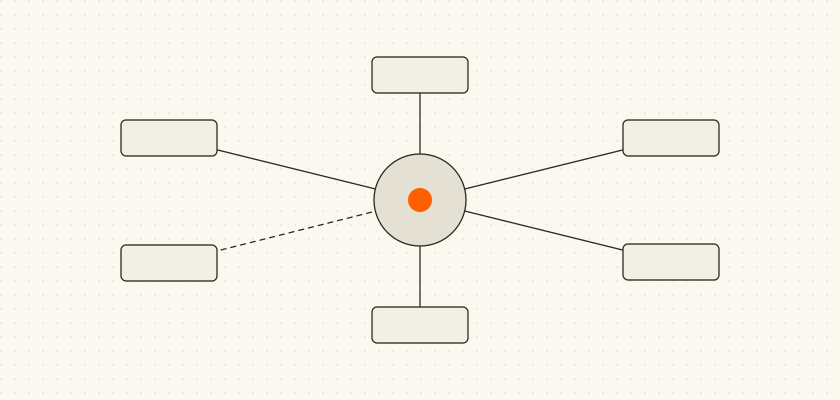
AI agents are software systems that can pursue a goal on your behalf. They perceive what is happening, decide what to do next, use tools and other software to act, and adjust as they go, with little or no step by step human instruction.
If a chatbot answers a question, an AI agent gets a job done: it reads the email, checks the system, updates the record, and tells you it is finished.
There is more noise around AI agents than almost any technology in years, and a good deal of it is either oversold or simply unclear.
This page is for the person paying the bill rather than the one writing the code: a UK business owner or operations lead trying to judge whether an agent is genuinely worth it.
It sets out what an agent really is, how it behaves once you strip the marketing away, where it earns its place, and what it costs to run.
It also answers the question the vendor pages tend to skip, which is whether you are better off buying something off the shelf, adopting a platform, or having an agent built around the systems you already use.
Where the promise runs ahead of what the technology can currently do, we say so.
A quick note on where we sit. Sizrok builds and maintains bespoke automations that wire your existing tools together: your CRM, your inbox, your finance system, your spreadsheets. So this is not a pitch for another product to bolt on.
It is a practitioner's view of what these things do once they are actually running inside a real business.
What are AI agents?
An AI agent is a system that uses a large language model (LLM) as its brain to independently plan and carry out tasks toward a goal, calling on external tools, data and other software to get there.
The defining trait is autonomy: you give it an objective such as "reconcile yesterday's invoices" or "triage the support inbox" rather than a script, and it works out the steps itself.
That autonomy is what separates an agent from the two things people confuse it with.
A chatbot responds. You ask, it answers, and the exchange ends there. It has no ability to go and do anything in your other systems.
A traditional automation, meaning a fixed rule or an "if this, then that" flow, does act, but only along a path a human wrote in advance, so the moment reality deviates from the script it breaks. An AI agent sits between and above both.
It can decide the path itself, handle exceptions it was not explicitly told about, and use tools to complete the work, then loop back and check it actually worked.
There is also a term you will see used interchangeably but should not. "Agentic AI" describes the broader capability, meaning AI that can act with autonomy, while an "AI agent" is a specific system built to do it. Every AI agent is agentic AI.
Not every discussion of agentic AI is about a deployable agent. If you are starting further back, what artificial intelligence actually is covers the foundations these agents are built on.
Is ChatGPT an AI agent? By default, no. Standard ChatGPT is a conversational assistant. It generates responses but does not autonomously act across your other systems.
It edges toward being an agent when given tools such as browsing, code execution or connected apps, plus a goal to pursue independently. The distinction is action: an agent does not just tell you what to do, it does it and reports back.
How do AI agents work?
Every capable AI agent, whatever the vendor calls it, rests on four capabilities working in a loop.
Perception. It takes in information: your prompt, plus live data from the systems it is connected to, such as a CRM record, an email, a database row or a document.
Reasoning and planning. The LLM at its core breaks the goal into steps and decides what to do first. Modern agents use planning patterns, such as the ReAct and ReWOO frameworks that IBM documents, to interleave thinking with doing rather than guessing everything at once.
Action through tool use. This is the part that makes it an agent rather than a chatbot. It calls tools: an API to your accounting software, a function that sends an email, a query against your database. Tool use is how thinking becomes a completed task.
Memory and reflection. It holds context across the steps of a task, which is short term memory, and in more advanced setups it retrieves relevant past information or documents to inform decisions.
That retrieval piece is often powered by RAG, and our guide to RAG (retrieval augmented generation) explains how an agent grounds its answers in your data rather than the model's generic training.
Put together, the working cycle is: plan, use a tool, observe the result, decide the next step, and repeat until the goal is met.
A support triage agent, for example, reads an incoming ticket (perception), decides it is a refund request (reasoning), looks up the order in your system (tool use), remembers the customer's earlier messages in the thread (memory), issues or escalates the refund (action), and confirms it is done.
If the order lookup fails, a well built agent does not crash. It tries an alternative or flags it for a human. That exception handling is precisely what a rigid automation cannot do.
Types of AI agents
Agents are usually classified from the simplest to the most capable: simple reflex agents that act on the current input via fixed rules, model based reflex agents that keep an internal model of the world, goal based agents that choose actions that move toward a defined goal, utility based agents that weigh trade offs to pick the best action rather than just a valid one, and learning agents that improve from feedback over time.
A newer distinction matters more for business: single agent systems versus multiagent systems, where several specialised agents collaborate, one planning, one researching, one executing, under an orchestrator.
Each type suits a different kind of task. If you want to match a type to a specific job you have in mind, our deeper look at the types of AI agents walks through them one by one.
AI agent use cases and examples
The useful question is not "what can agents do in theory" but "where do they earn their keep in a real business." In practice, the strongest AI agents for business cluster around high volume, rules heavy, judgement light work:
Customer support: triaging tickets, drafting replies, pulling order details, and escalating the genuinely tricky cases to a person. Sales and CRM: enriching leads, logging activity, chasing follow ups, and keeping the pipeline tidy so your salespeople sell instead of typing.
Operations: moving data between systems that do not talk to each other, generating routine documents, and reconciling records. Finance: matching invoices to purchase orders, flagging anomalies, and prepping month end. HR: handling onboarding checklists, answering policy questions, and routing requests.
A concrete UK example from the kind of work we do: a midsized professional services firm was losing roughly a day a week to manually copying new client details from intake emails into their CRM and finance system.
An agent now reads each intake email, extracts the details, creates the CRM record and the finance entry, and sends the client the onboarding pack, with a human check only on anything it flags as ambiguous. The point is not the technology.
It is that a repetitive, error prone job stopped needing a person.
If one of those sounds like a job you would recognise from your own week, we break the common patterns down function by function in our guide to AI agent use cases, and look at what adoption actually tends to look like in how businesses are using AI agents day to day.
A word on hype versus reality, because the honest answer serves you better than the excited one. Not every process should be handed to an agent.
Where the work needs professional judgement, a relationship, accountability, or genuine creativity, such as advising a client, closing a complex deal, or deciding strategy, the agent is a support tool, not a replacement. AI agents remove the admin and ops drag around your experts. They do not replace the experts.
The businesses that get value are ruthless about pointing agents at the boring, repeatable middle and keeping people on the parts that actually need a person.
Build versus buy versus bespoke
This is the decision almost no guide will help you with, because the big authority pages are written by vendors who would rather you bought their platform. Here is the honest version.
Buy off the shelf when your need is common and self contained, such as a customer service agent widget or a meeting notes agent. It is fast and cheap to start. The limit: it lives in its own silo and rarely fits the specific way your business runs.
Adopt a platform, meaning build your own on a vendor's toolkit, when you have technical capacity in house and want to assemble agents yourself. You get flexibility, but you own the build, the maintenance, and the integration headaches, and those headaches are where most internally built agents quietly stall.
Have it built bespoke when the value is in connecting the systems you already run, meaning your specific CRM, inbox, finance tool and spreadsheets, and automating a process that is particular to your business.
This is the case the vendor pages ignore, and it is the one most established SMEs actually fall into, because your problem usually is not "I need an agent," it is "I need my six systems to work as one without a person copying data between them."
The honest rule of thumb: if an off the shelf tool already does exactly what you need, buy it and do not overcomplicate it.
If your value lives in the glue between your existing systems, a bespoke build around that stack will beat a generic product every time, because a generic product cannot know your workflow.
That integration first, done for you approach is exactly what we do at Sizrok, but the rule stands whoever builds it.
What do AI agents cost?
The ranking pages dodge this question, usually because there is no single price to quote. We will not dodge the structure of it, because once you understand what actually drives the cost you can estimate your own case better than any headline figure would let you.
Cost splits into two parts. Build cost is designing, building and integrating the agent with your systems, which scales with how many systems it touches and how much bespoke logic it needs.
Run cost is the ongoing model and API usage, where you pay per unit of work the underlying LLM does, plus hosting and maintenance. A simple single task agent on top of a tool you already own can be near trivial to run.
A multiagent system reasoning over large documents all day costs meaningfully more, because compute is the recurring bill.
The drivers to watch: the number of systems integrated, the volume of tasks per month, how much reasoning each task needs (long documents and complex decisions cost more than short lookups), and the level of human oversight and logging you require.
A well scoped agent aimed at a genuinely high volume process typically pays for itself through the staff time it frees, but only when it is pointed at the right process, which is why the mapping step below matters more than the tooling.
The most reliable way to know your own number is to scope the specific process rather than trust a generic figure, which is exactly what an audit is for.
Benefits and why use AI agents
The benefits of AI agents, stated plainly and with sourcing rather than the unsourced stats the listicles recycle:
They do multi step work, not just answer questions. That is the step change over chatbots and rigid automations, because an agent completes the task end to end.
They handle exceptions. Because they reason rather than follow a fixed script, they cope with the messy, off pattern cases that break traditional automation.
They scale a process without scaling headcount. The repetitive middle of your operations gets faster and more consistent, freeing people for judgement work.
On the numbers: analysts expect agentic AI to move from novelty to normal quickly.
Gartner has projected that by 2028 a third of enterprise software applications will include agentic AI, up from effectively none in 2024, and the same analysts expect more than 40 percent of agentic AI projects to be cancelled by the end of 2027, mostly for weak scoping rather than weak technology.
Deloitte's State of Generative AI in the Enterprise work, meanwhile, reported organisations citing strong returns on their most scaled AI initiatives.
Treat headline ROI figures with care: the returns are real for well scoped deployments and thin to negative for rushed ones. The variable is not the technology, it is the discipline of what you automate, which is the whole point of the honest framing above.
Why use AI agents at all, then? Because a large share of what your team does every day is repetitive, rules based admin that drains time without needing human judgement.
An AI agent absorbs that work so your people spend their hours on the things only people can do: advising, deciding, and building relationships. Used well, it is leverage on your existing team, not a replacement for it.
Best practices and how to get started
The single biggest predictor of whether an agent delivers is not the model you pick. It is whether you mapped the process before you automated it. Automate a broken process and you get a faster broken process.
A sensible sequence to get started with AI agents:
Start by writing the process down as it really runs, not as the handbook describes it. The exceptions are the part that matters: the odd cases, the manual check somebody does on a Friday, the step everyone forgets to mention. An agent meets those on day one.
Pick a high volume, low judgement candidate. Start where the work is repetitive and the stakes of a mistake are recoverable. Prove it, then expand.
Build in oversight from day one. Activity logs, a human approval checkpoint for anything consequential, and a clear way to interrupt or override the agent. IBM's own best practice list stresses exactly this: logging, interruptibility, unique agent IDs and human supervision. It is right.
Measure against the before. Time saved, errors reduced, throughput up. If you cannot measure it, you cannot tell whether it worked.
If a term trips you up along the way, our plain English glossary of AI agent terms is a quick place to check.
AI agent questions worth asking before you buy
Working out whether an AI agent suits your business
If you are weighing this up for your own business, the honest starting point is not choosing an agent. It is identifying which of your processes is actually worth automating and how it connects to the systems you already run.
That is the conversation we have on an automation audit: we look at your workflow, tell you straight whether an agent is the right answer, and if it is, build it around your existing stack rather than adding another tool for your team to learn.
When it is the right answer, our workflow agents service is where we build and maintain it for you.
Ready to work out what is worth automating in your operation? Book an automation audit and we will map it with you.