The AI integrations guide
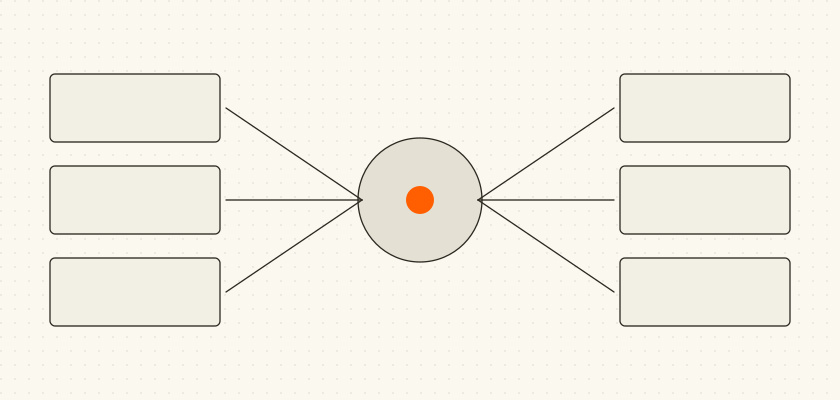
Most guides on this topic quietly assume you are starting from nothing, and then sell you a platform to fill the void. The reality for almost every UK business is the opposite.
You already run Microsoft 365 or Google Workspace, a CRM, an accounts package, and a handful of other tools, and the useful question is not which platform to adopt but how to make AI work across the systems you already own.
AI integration, done well, is layering capability onto that stack, not replacing it.
AI integrations are the connections that let artificial intelligence read from, write to, and act inside your existing business tools.
That covers everything from a built in assistant summarising an email, to an automation that moves data between two apps when something happens, to a bespoke agent that carries out a multi step task across several systems on its own.
This guide, written for the person evaluating options rather than the person coding them, sets out what the word actually covers, the three layers it hides, and how to tell which one your situation needs.
What are AI integrations?
An AI integration is any arrangement that connects an AI capability to a business system so the two can exchange data and trigger actions. In practice the term hides three quite different things, and most confusion about AI integration comes from treating them as one.
It helps to name them as three layers, from lightest to heaviest.
The first layer is native AI features: the assistants already built into software you own, such as Copilot inside Microsoft 365 or Gemini inside Google Workspace. Nothing to connect, because the vendor has done it; you switch on a capability that already lives where your work does.
The second layer is middleware automation: tools like Zapier, Make, and n8n that sit between apps and pass data along with simple "when this happens, do that" rules.
The third layer is bespoke integration: a build that connects directly to your systems through their interfaces, or an agent that reasons across several of them, shaped around your specific process.
Each layer is a legitimate answer to a different problem, and the whole art of choosing well is matching the layer to the job rather than defaulting to whichever tool you saw advertised.
How an AI integration connects your tools
Underneath all three layers, the mechanism is the same. Software exposes an interface, usually an API, that lets other software request data or trigger an action in a controlled way.
An AI integration uses those interfaces to fetch the information the AI needs, feed it in, and then push the result back out to wherever it belongs, whether that is a CRM record, a document, or an email.
What differs between the layers is who does the connecting and how much reasoning happens in the middle. In a native feature, the vendor owns the plumbing and you simply use it. In middleware, you assemble the connections yourself from prebuilt blocks, defining the triggers and the steps.
In a bespoke build, the integration is written to fit your process exactly, and where an agent is involved it can decide the order of steps rather than following a fixed script.
The more judgement the task requires, and the more systems it touches at once, the further up the layers you tend to move.
Types of AI integration, and when each fits
Native AI features
If the capability you want already exists inside a tool you pay for, start there. Copilot and Gemini handle summarising, drafting, and searching within their own environments with no setup and no extra integration risk.
The limit is that they mostly work within their own walls; they are not designed to orchestrate a process that spans your CRM, your accounts system, and a courier's tracking data.
No code middleware
Zapier, Make, and n8n are the right tool for simple, well defined connections between apps, especially early on. They are quick to set up and need no developer.
Their honest limits show at scale: they add a small delay to each step, they usually charge per task so cost climbs with volume, and long chains of rules become fragile and hard to debug when a workflow grows complicated.
Middleware is a floor to start on, not a ceiling to aim for.
Bespoke API and agent builds
When a workflow is high volume, spans several systems, or carries real consequences if it goes wrong, a direct integration built around it is usually cheaper to run and more reliable over time than a long middleware chain. This is also the layer where the 2026 shift is happening.
Agentic integrations, such as those emerging in mainstream CRM platforms, move from fixed trigger and action rules toward AI that executes a multi step task across systems and adapts as it goes.
That is a genuine change from the automation most middleware guides still describe, and it is worth understanding before you assume the two are the same thing.
AI integration use cases for businesses
The concrete uses map onto the systems you already run. In a CRM, an integration can enrich a new lead, draft a first response, and log the interaction without anyone retyping anything, which our CRM automation guide covers in depth.
In the inbox, it can triage incoming email, extract the request, and route or draft a reply, as our email automation guide explains.
Inside Microsoft 365 and Google Workspace, native and bespoke integrations can summarise documents, prepare reports, and search across your files, covered in our guides to AI for Microsoft 365 and AI for Google Workspace.
To make that concrete, picture a small distributor whose sales team logs orders in one system, whose warehouse tracks stock in another, and whose accounts run in a third. Today a person opens all three every morning and reconciles them by eye.
A middleware connection could pass a new order from the first system to the second, which already saves keystrokes.
But when the real need is to check stock, flag shortfalls, update the ledger, and email the customer if something is delayed, all in one reliable pass, that is a bespoke integration with an agent making the calls.
The same business might use all three layers at once: a native summary feature in its email, a middleware rule for a simple hand off, and a bespoke build for the reconciliation that actually matters. Choosing the layer per task, not per company, is the whole point.
Across all of them the winning examples share a shape: a repetitive task that moves information between systems, where a person currently acts as the connector. That is the work integration removes.
Where the task also needs judgement rather than just movement, an AI agent can sit on top of the integration and make the decisions, which is the difference between a pipe and something that acts through it.
How to choose: build, buy, or middleware
The one question no platform guide can answer neutrally is the one every evaluator actually has: build, buy, or connect with middleware. A workable decision frame runs in that order of increasing commitment. If a native feature in software you own already does the job, use it and stop.
If not, and the connection is simple, low volume, and unlikely to change much, middleware is the fastest sensible route.
Move to a bespoke build when the workflow is high volume, spans several systems, carries real risk if it fails, or when the per task cost and fragility of middleware start to outweigh a build that runs cleanly on your own infrastructure.
Two things sit alongside that choice for UK businesses. First, data handling: because integrations move information between tools, you need to know where each tool processes and stores data, and whether it trains models on yours, which matters especially in regulated sectors.
Second, security: connecting AI to live systems widens what can go wrong, so integrations should be designed with proper access limits from the start. The UK's National Cyber Security Centre guidelines for secure AI system development are a sound, vendor neutral reference for what "secure by default" should mean here.
When the decision lands on a build that ties several tools together, our work on connecting disconnected systems is where we do exactly that.
AI integration questions UK teams ask
Planning your first AI integration
The useful conclusion is that "AI integration" is not one decision but three, and choosing well means matching the lightest layer that will actually do the job: a native feature if one exists, middleware for simple connections, and a bespoke build only where volume, complexity, or risk earns it.
Which layer fits your situation depends on the systems you already run and the specific work you want to remove, not on which platform markets to you hardest.
An automation audit is how we settle it: we look at where your people currently act as the connector between systems, judge which layer each workflow genuinely needs, and design any build securely around the stack you already have.
When that points to a build, our workflow agents service is what takes it from plan to something that runs day to day.
From here, the spoke guides go deeper on the systems most UK businesses start with: CRM automation, email automation, AI for Microsoft 365, and AI for Google Workspace.