AI vs automation: what’s the difference?
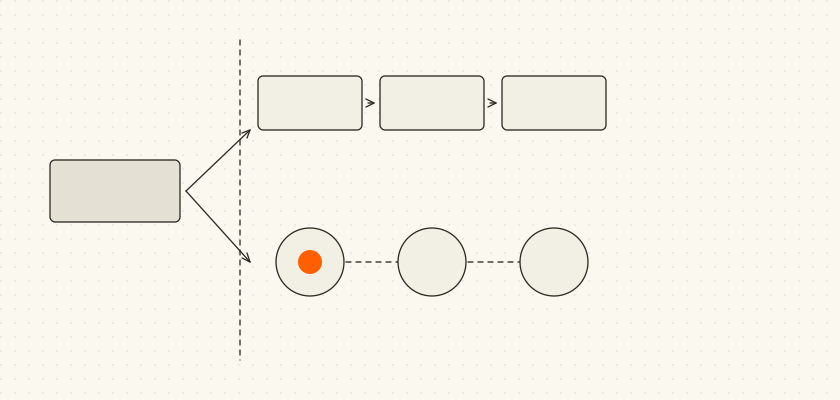
The short answer to AI vs automation is that they are not rivals, they are layers. Automation follows a fixed path a person laid down in advance: when this happens, do that, every time, at speed and without complaint.
AI does something automation cannot, which is decide: it reads a situation it was not given explicit rules for, weighs it, and chooses. Almost every article framing this as a choice between the two is a generation behind.
In 2026 the useful question is not which one you buy but how they fit together, because the strongest setups use AI to make the decisions and automation to carry them out.
Written for the owner or operations lead of a UK firm who keeps seeing the two words used interchangeably and wants the distinction made clearly, along with an honest sense of when each is worth the money. It is not written for engineers.
The pages that rank for this question are mostly enterprise vendors and workflow tool makers, and they share a habit: they want you to buy something today, so they skip the part where automation alone is often cheaper, faster and entirely sufficient. This page does not.
This comparison comes from doing both kinds of work for clients, which means we regularly build both plain automation and AI enhanced automation, and choose between them on the merits.
So we can afford to tell you when the plain, cheaper option is the right one. This spoke sits under our pillar guide to artificial intelligence, which is the place to start if you want the wider picture.
What is the difference between AI and automation?
Automation executes predefined rules consistently and at scale; AI learns from data, makes decisions, and copes with situations no one wrote a rule for. The cleanest way to hold the difference is this: automation follows a path, AI chooses one.
Give automation a structured, repeatable task and it will do it perfectly a thousand times over, but hand it something ambiguous and it stops, because there is no rule to follow.
AI is built for exactly that ambiguity, interpreting an unstructured document or an oddly worded request and deciding what to do, at the cost of being probabilistic rather than certain. That single contrast, fixed path versus chosen path, is the whole distinction, and everything below is detail hanging off it.
What is automation?
Automation is rule based execution: a trigger fires, a condition is checked, an action follows. It does not learn and it does not adapt; it does exactly what it was told, which is precisely its strength.
Automation excels at high volume, structured, repeatable work with few exceptions, where reliability matters more than cleverness.
Typical examples at the scale of a small business include routing an incoming invoice to the right approver, updating a field across your CRM when a deal closes, generating and sending a scheduled report every Monday, or running a fixed sequence of follow up emails.
None of these needs judgement; they need doing consistently and quickly, which is what automation is for.
Because it does not depend on data to learn from and carries no model to train, it is cheaper and faster to deploy than AI, and it is often all a process actually requires.
For the broader discipline of stringing these actions into full processes, our guide to business process automation covers the ground.
What is AI?
AI is software that learns patterns from data and uses them to make decisions on inputs it has never seen before, including messy, unstructured ones.
Where automation needs a rule, AI infers from examples, which lets it read a scanned document, classify an email by its intent, or draft a reply in context.
In 2026 the dominant form is agentic AI: systems that do not just answer a single prompt but plan a short sequence of steps, decide what to do at each one, and trigger downstream actions to carry the plan out.
That is the capability that lets AI sit at the decision points of a process rather than just its edges.
The trade is that AI is probabilistic, so it can be confidently wrong, which is why anything it decides that carries real consequence needs a person or a check in the loop. The kinds of AI, and how generative models fit in, are covered in what is generative AI.
AI vs automation: the key differences
Set side by side, the differences are easy to see. This comparison deliberately includes the two rows vendor tables tend to drop, failure mode and oversight, because those are the honest ones.
| Dimension | Automation | AI |
|---|---|---|
| How it decides | Follows fixed rules | Learns from data, infers |
| Input it handles | Structured, predictable | Unstructured, ambiguous |
| Adaptability | None, does as told | Adapts to new inputs |
| Data required | Little | Substantial, and clean |
| Cost to deploy | Lower | Higher |
| Speed to value | Fast | Slower |
| Failure mode | Stops at an exception | Confidently wrong |
| Oversight needed | Light | Real, for anything consequential |
The table makes the practical point on its own: automation is the cheaper, faster, more predictable tool, and AI is the more capable but more demanding one.
Neither is better in the abstract; they are suited to different work, and the skill is matching each to the task that fits it. The technical terms in the table are defined in our AI glossary.
How AI and automation work together
The framing that gets closest to how modern systems are actually built is not "AI or automation" but "AI and automation, layered". AI makes the decision; automation does the moving. Naming that combination is the thing most explanations miss, and it is the shape of nearly every worthwhile build.
Take a familiar example to see the layers. An invoice arrives in a shared inbox. Automation notices it and routes it into the process.
AI reads the document, which is unstructured and formatted differently by every supplier, and extracts the figures that matter. Automation takes those structured figures and posts them into the accounting system.
Then a rule kicks back in: anything above a set value, or anything the AI flagged as uncertain, is held for a person to approve, while the routine, low value, high confidence cases flow straight through. Every layer is doing what it is best at.
Strip out the AI and a person has to read every invoice; strip out the automation and the AI's decision goes nowhere. Together they turn a job that ate an afternoon into one that runs in the background with a human watching only the parts that need watching.
Designing that hand off between decision and execution across your own systems is precisely the work our complete workflow automation guide walks through.
When to use automation, when to use AI, when to use both
The decision is more straightforward than the vendors make it sound. If the work is structured, high volume and low in exceptions, start with automation alone, because it is cheaper, quicker to stand up, and probably all you need.
If the work involves unstructured input, or a decision that depends on context an explicit rule cannot capture, that is where AI earns its cost, so add it at the decision point and leave the execution to automation.
And where a process has both a genuine judgement step and a lot of routine coordination around it, the honest answer is both, layered into a single build.
The one caution worth stating: AI adds cost, complexity and a dependence on decent data, so reaching for it when plain rules would do is a common and expensive mistake. Choose the lightest tool that does the job, and only add intelligence where the job actually requires it.
It helps to be blunt about the cost gap the vendor pages gloss over. Plain automation is comparatively cheap to build and quick to prove, because the logic is explicit and there is nothing to train.
AI carries a heavier bill: it needs data of reasonable quality to work from, it takes longer to get right, and it needs ongoing attention as inputs drift and the model's decisions are checked against reality. That does not make AI a bad investment; it makes it a targeted one.
The pattern that pays back is a mostly automated process with a single well chosen AI decision point inside it, rather than intelligence sprinkled everywhere.
Working out where that one point sits, and whether the process even has one, is worth more than any comparison of tools, because it is the difference between a build that earns its keep and one that quietly costs more than the manual work it replaced.
The questions behind choosing AI or automation
Deciding between AI and automation for a given process
The practical takeaway is that AI versus automation is the wrong question.
The right one is which parts of a given process need only reliable execution, which parts need genuine judgement, and how the two should be wired together, and that is a question about your specific process and systems rather than about the technology in the abstract.
An automation audit is built to answer it: we look at how a real process runs, mark where plain automation is enough and where AI genuinely earns its cost, and shape any build around the systems you already have.
When that becomes something to build and run, our workflow agents service is how we deliver it.
For the layer beneath this comparison, the pillar guide to artificial intelligence explains what AI is and is not, and a broader authority view of the agents versus automation distinction is set out in the AWS Executive Insights guide, AI agents vs automation.