What is generative AI?
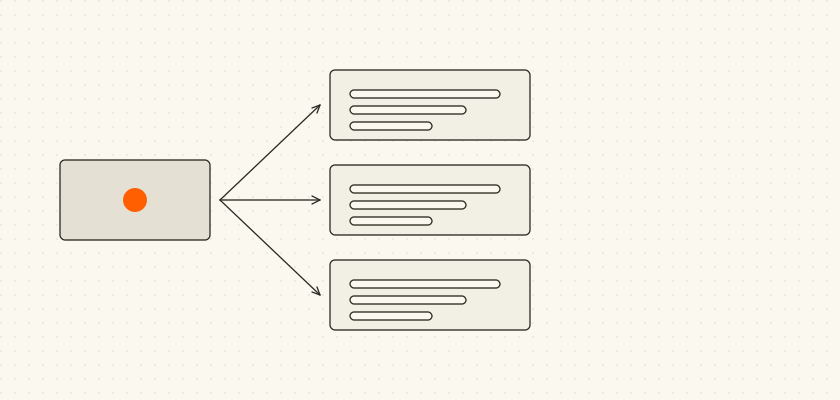
Generative AI is artificial intelligence that creates new content, text, images, audio, video or code, rather than simply classifying or predicting from data that already exists. Ask it a question and it writes an answer; describe an image and it produces one.
The one line worth memorising is the contrast at its heart: predictive AI sorts and forecasts what is already there, while generative AI makes something new. That difference is why this branch of AI, and not any other, is the one that has reached ordinary desks.
This guide is for the owner or operations lead of a UK business trying to understand what generative AI is and where it genuinely fits, before deciding whether to use it. It is not written for developers.
Most pages ranking for this question are either enterprise vendor explainers or consumer pieces about writing essays with ChatGPT, and neither shows a 10 to 200 person business how to put the technology to work responsibly. This one does, limits included.
Generative AI is one branch of the wider field covered in our guide to artificial intelligence; if you want the full picture of AI as a whole, start there.
Our vantage point, briefly: generative models are something we put to work inside client systems rather than something we sell, so we treat generative AI as a component to be used carefully inside a workflow, not a magic box, and we will say where it should not be trusted.
What is generative AI?
Generative AI is a type of artificial intelligence that produces new content, such as text, images, audio, video or software code, in response to a prompt.
It is powered by large language models and other foundation models trained on very large datasets, which learn the patterns of their training material well enough to generate fresh, coherent output rather than retrieve a stored answer. That is the generative AI definition in a form worth quoting.
The distinction from ordinary AI is the whole point, so it is worth stating plainly. Predictive AI answers questions like "which of these emails is spam?" or "how likely is this lead to convert?" by classifying existing data.
Generative AI answers "write a reply to this email" or "summarise this document" by creating new material. Both are AI; only one generates. When people say "AI" in 2026 and mean the thing that writes and converses, generative AI is what they are describing.
For how this differs from rules based automation more broadly, our comparison of AI and automation draws the line clearly.
How does generative AI work?
Here is the generative AI meaning made mechanical, without the maths. The engine of most generative AI is the large language model, or LLM.
It is trained by being shown an enormous quantity of text and learning to predict what comes next, over and over, until it can produce fluent, contextually appropriate language.
The architecture that made this work well is called the transformer, which lets the model weigh how every part of an input relates to every other part.
You do not need the internals; the useful mental model is a system that has absorbed the patterns of vast amounts of human writing and can extend them on demand.
When you give it a prompt, it generates a response one piece at a time, each choice shaped by everything before it.
This is why the same question can yield slightly different answers, and why how you phrase the prompt matters so much, a skill covered in our guide to prompt engineering basics.
The current baseline, and the thing many older explanations miss, is that leading models are now multimodal. Rather than handling text alone, a single model can take in and produce a mix of text, images and audio.
In practice that means you can show a model a photograph of an invoice and ask it to extract the figures, or hand it a recording and ask for a summary. Treating generative AI as a text only tool understates what the 2026 generation can actually do.
Types of generative AI
The types of generative AI are best organised by what they produce. Text generation, driven by LLMs, writes, summarises, translates and answers. Image generation, driven by a different design called diffusion models, produces pictures from a description.
Audio generation creates speech and music, including realistic synthetic voices. Video generation, the newest and least mature, produces moving footage from prompts. Code generation writes and explains software, and has become a genuine productivity tool for developers.
Each is a distinct model type under the same generative umbrella, and the technical terms behind them are defined in our AI glossary.
Generative AI use cases for UK businesses
For a UK small or midsized business, the strongest generative AI use cases are unglamorous and valuable: the drafting, summarising and answering work that fills a working week.
Drafting is the obvious one, producing a first version of an email, a proposal, or a customer reply for a person to refine and send. Summarising is close behind, turning a long thread, document or meeting transcript into the few lines someone actually needs.
Internal question answering is powerful when the model is connected to your own documents, letting staff ask a plain question and get an answer drawn from your policies or records rather than searching for the file. Content repurposing turns one piece of material into several formats.
And for teams that write software, code assistance speeds routine work. The pattern across all of them is the same, and it is the one that matters: generative AI drafts, a human decides.
Used that way it is an accelerator; used as an unattended author it is a liability, which brings us to the limits.
Generative AI risks and limitations
This is the section vendor pages skip, and it is the one that protects you. Generative AI is genuinely useful, but it has failure modes you must design around rather than hope away.
The first is hallucination: models can produce fluent, confident output that is simply untrue, because they generate plausible language rather than check facts. Anything touching a real decision needs a human review step or grounding in your own verified data.
The second is intellectual property and creative rights: models are trained on large bodies of existing work, and the question of who owns AI generated output, and whether it infringes, is legally unsettled and genuinely contested, particularly by artists and writers.
Treat generated content as a draft to be checked, not a finished, safe asset. The third is data protection.
If you feed personal data into a generative tool you take on obligations under UK GDPR, and where and how that data is processed matters; the Information Commissioner's Office sets out guidance on AI and data protection that any UK business should read before putting customer data near a model.
The fourth is simple over dependence: output quality varies, and a team that stops checking will eventually send something wrong. None of these rule generative AI out. They rule out using it carelessly.
How to use generative AI in your business
The mistake most businesses make is treating generative AI as a standalone chatbot to visit, when its real value comes from placing it inside a workflow.
A generative AI tutorial in one sentence: find a step in an existing process that involves drafting or summarising, insert a model to do the first pass, add a human review before anything leaves the building, and connect the result to whatever happens next.
So begin with a specific workflow rather than the technology. Identify a drafting or summarising task that recurs often enough to matter. Decide which model or service fits, keeping the data protection point above in mind.
Build in the review step explicitly, because it is what makes the whole thing safe to rely on. Pilot it narrowly, measure whether it genuinely saves time and holds quality, and only then widen it.
The review step deserves a little more thought than it usually gets, because it is what separates a useful tool from a quiet liability.
A good review is not a rubber stamp; it is a person who knows the subject reading the output with the specific question "would I be comfortable sending this as it stands?" For low stakes internal drafts that bar can be light.
For anything a customer sees, or anything that feeds a decision, it should be firm, and the person doing it should have the source material to check against.
Design the workflow so that reviewing is quicker than writing from scratch, and the time saving is real; design it so reviewing is an afterthought, and the errors will eventually slip through.
Where generative AI stops being a single assisted step and starts planning and acting across several, it shades into AI agents, which is the next concept worth understanding if that is the direction you are heading.
Generative AI questions we hear most
Putting generative AI to work in your business
Generative AI is one of the most useful tools a business has gained in years, and one of the easiest to misuse.
The productive path is not to adopt a chatbot and hope, but to find a specific drafting or summarising step in a real process, build in the review that keeps it safe, and connect it to the systems you already run.
An automation audit is where we help with that: we look at how you actually work, point to the step where generative AI would genuinely pay off, and make sure it fits the tools you already have rather than adding another.
If it turns into something we build, that runs through our workflow agents service.
If you want the wider context first, our pillar guide to artificial intelligence sets generative AI in its place among the other kinds.