AI knowledge bases: a complete guide
Search this topic and almost every result sells you the same thing: a customer support tool that deflects tickets. That is a real use, but it is the smaller half of the story, and the half that already has a dozen vendors competing for it.
The larger, quieter problem is internal. It is the hours your own staff lose hunting across SharePoint, Confluence, shared drives, and old Slack threads for a policy or a process they know exists somewhere.
This guide covers both, but it gives the internal half the attention the rest of the web skips.
An AI knowledge base is a structured collection of your organisation's documents, policies, and data that an AI system can retrieve from and reason over, giving it accurate, traceable answers grounded in your information rather than generic training data.
That grounding is the whole point, and it is what separates it from a chatbot that sounds confident and makes things up. If you have read our RAG guide, you already know the mechanism; this page is about what to do with it.
What is an AI knowledge base?
A traditional knowledge base is a static library: articles filed under categories, found by keyword, and read by a person who browses until they land on the right page. An AI knowledge base inverts that. It is designed for machine retrieval rather than human browsing.
Instead of you searching for a document and reading it, you ask a question in plain language and the system finds the relevant passages across many documents, then synthesises a single grounded answer with its sources attached.
The architectural difference that matters is that word "designed for machine retrieval". A traditional knowledge base assumes a human will do the reading and the judging. An AI knowledge base assumes the machine will retrieve the right material and the human will check the answer.
That shift is why an AI knowledge base can search across a dozen systems at once and return one answer, where the old model made a person open each system in turn and stitch the answer together in their head.
How an AI knowledge base works
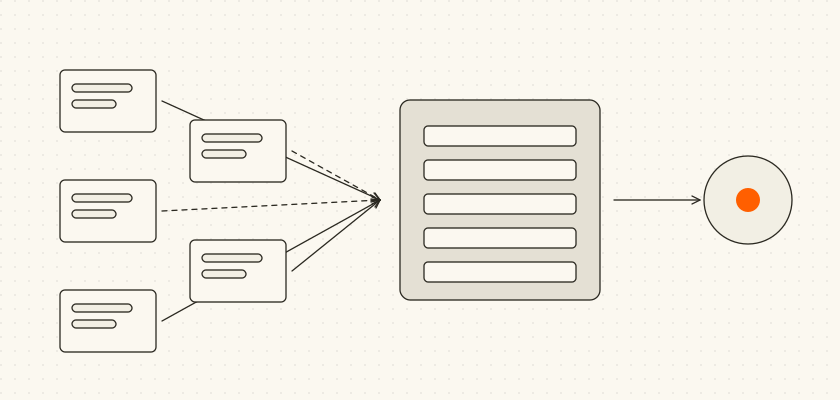
Under the surface, an AI knowledge base is a retrieval system, and it runs the same pipeline in every serious build. First, your documents are split into passages and turned into embeddings, then stored in a vector database so they can be searched by meaning.
Second, when a question arrives, semantic search finds the passages most relevant to it. Third, those passages are handed to a large language model as context. Fourth, the model writes an answer grounded in that context, ideally with a citation back to the source document.
The reason this matters commercially is in step four. Because the answer is built from your retrieved passages rather than from the model's training, it reflects your current policies and your specific data, and it can point to where it came from.
A staff member can trust it because they can check it. That traceability is the feature regulated and cautious businesses actually pay for, and it is the thing a generic public chatbot cannot offer, because it has never seen your documents.
Internal versus external AI knowledge bases
The single most useful distinction to hold in your head is who the knowledge base serves.
Internal, staff facing
This is the overlooked one. An internal AI knowledge base answers the questions your own people ask each other all day: where is that policy, what is the process for onboarding a new client, which supplier did we approve for this, what did we agree in that contract.
It searches across your internal wiki, your document stores, and your chat history in one query, and it hands time back to people who currently spend it hunting. For most established businesses this is the larger prize, precisely because it is where the most hours are quietly lost.
External, customer facing
This is the one the market already sells hard. It powers support chatbots, self service portals, and product FAQs, answering customer questions from your published help content and product documentation. It is genuinely valuable, and for common, repetitive customer questions an off the shelf tool often does the job well.
The gap is not here; the gap is that the internal use case rarely gets built because no vendor is loudly selling it to you.
What UK teams use an AI knowledge base for
The concrete applications follow from those two lanes.
Internally, the common wins are a staff assistant for HR policies and IT helpdesk questions, an onboarding companion that answers a new hire's questions without occupying a colleague, and a compliance or regulatory Q&A tool that returns the current rule with its source.
Externally, the wins are a support bot grounded in your product documentation and a self service portal that resolves routine questions before they become tickets. Across sectors, contract and document search sits usefully in both lanes.
These are not hypothetical at scale. Large organisations have connected retrieval across dozens of internal data sources and hundreds of thousands of documents, and regulated firms have used grounded retrieval to take real cost out of compliance work over multi year horizons.
The point of citing that is not the specific numbers, which vary by case, but the shape: the value grows with the volume of knowledge and the frequency of the questions.
A business with a modest set of documents and few repeated queries will see a modest return, and it is honest to say so before anyone builds anything.
AI knowledge base versus search versus chatbot
Buyers often conflate three things that are not the same, and buying the wrong one is a common, expensive mistake. Search finds documents and hands them to you to read. A chatbot is a conversational interface, the thing you type into.
An AI knowledge base is the knowledge layer that supplies accurate, grounded answers for the chatbot to deliver.
A chatbot without a knowledge base behind it is just a fluent guesser; a knowledge base without a chatbot in front of it is a retrieval engine with no friendly way to ask it questions.
In most real systems all three are combined, which is exactly why keeping them straight matters: you want to be sure you are buying the knowledge layer, not just the chat window.
Key considerations before you build one
An AI knowledge base is only ever as good as the documents underneath it, and this is the honest prerequisite most vendor pages skip. Outdated, duplicated, or poorly structured source material produces confident, wrong answers, and no clever retrieval fixes bad inputs.
Getting the content into shape is usually the first real piece of work, and often the one that decides whether the whole project succeeds.
Alongside content quality, four things deserve attention before a build. Access control and permissions: the system must respect who is allowed to see what, so a junior query never surfaces a document meant for the board.
Data residency and handling: UK and regulated businesses need to know where the data is processed and stored and whether any model trains on it. Maintenance: someone has to own keeping the documents current, or accuracy decays quietly over months.
And human oversight for high stakes answers, so that anything with legal, financial, or safety weight is checked before it is acted on. None of these are reasons not to build; they are the questions a competent build answers up front.
How to build an AI knowledge base from scratch
The first step is not choosing a tool. It is looking honestly at your documents and your questions. Which questions does your team ask over and over, which documents hold the answers, and are those documents accurate and reasonably organised?
That review, sometimes uncomfortable, tells you whether an AI knowledge base will pay for itself or simply automate the delivery of out of date information faster.
From there the path is to clean and organise the priority content, scope a small build against it, and measure the answers before widening the scope.
Our RAG guide covers how retrieval and generation fit together, our vector databases guide covers the store underneath, and for the terminology you will meet along the way, our automation glossary keeps the jargon in plain English.
If the knowledge base is meant to feed an assistant that also takes actions, our guide to AI agents covers that next layer. If you want the staff facing version built around your own documents, that is what our internal AI knowledge base build delivers.
Questions about building an AI knowledge base
Making an AI knowledge base your team actually uses
The takeaway worth keeping is that an AI knowledge base is only as valuable as the knowledge you put into it and the questions you genuinely need answered, and that the largest, least served opportunity is usually internal rather than customer facing.
Whether your documents and your day to day questions justify one, and whether an off the shelf tool or a bespoke build fits, depends on your specific systems and how your knowledge is currently kept.
An automation audit is where we work that out with you: we look at what your team searches for repeatedly, judge honestly whether a knowledge base would earn its cost or simply need a document clean up first, and design any build around the systems and access rules you already have.
When it becomes something to build, our workflow agents service is how we deliver it and keep it current.
For the technical foundation, our RAG guide explains the retrieval mechanism, and the UK's Information Commissioner's Office guidance on AI and data protection sets out how to handle personal data in systems like these.