RAG explained: retrieval augmented generation
RAG, short for retrieval augmented generation, is a way of connecting an AI language model to your own documents so its answers are grounded in your specific, current information rather than only in whatever it learned during training.
In plain business terms, RAG turns your policies, your product catalogue, your contracts and your CRM records into a live, queryable layer the model draws on when it answers.
The technique was introduced in a 2020 research paper from a team at Meta AI, and in the years since it has become the standard way to make a general purpose model give reliable answers about a particular business.
The single most important thing to understand about it in 2026 is counterintuitive: the hard part is not the AI writing the answer, it is finding the right information to hand it in the first place.
Intended for the owner or operations lead of a UK business who keeps hearing RAG mentioned by vendors and wants to understand what it actually is, why it matters, and where it fits, without needing to be an engineer.
Most pages that rank for this term are written for data engineers and stop at the architecture; they explain vectors and cosine similarity and never translate any of it into why your business should care or budget for it. This one does.
It is the pillar of our retrieval and knowledge cluster, and it links down to the component pieces, vector databases, the Model Context Protocol, and AI knowledge bases, if you want to go deeper on any part.
The framing here comes from practice: we build retrieval into client systems for a living, and RAG is one of the components we assemble, not a product we sell.
So this page is honest about where it works cleanly, where it fails, and what determines the difference.
What is retrieval augmented generation?
Retrieval augmented generation is an AI architecture that pairs a large language model with an external retrieval system, so the model's answers are grounded in specific, current documents rather than static training data alone.
Rather than relying on what the model absorbed during training, which is fixed, generic, and quickly out of date, RAG fetches the relevant passages from your own material at the moment of the question and gives them to the model as context to answer from.
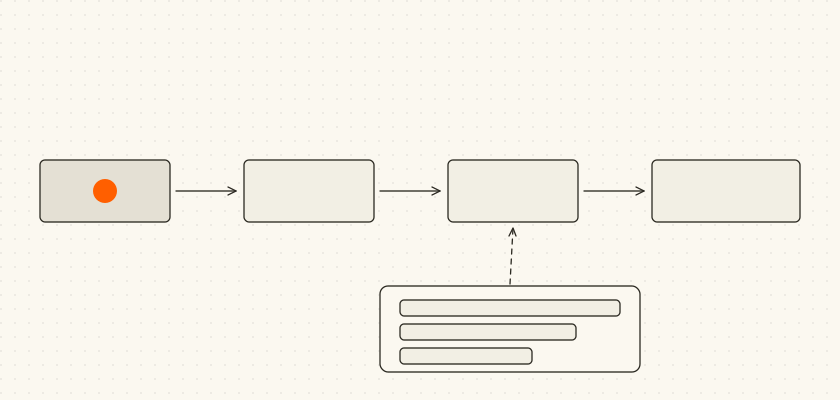
The mechanism has three steps, and they are worth holding in mind because everything else hangs off them. First, retrieve: given a question, the system searches your documents and pulls out the passages most likely to contain the answer. Second, augment: those passages are attached to the question as context.
Third, generate: the model writes an answer using that supplied context rather than guessing from memory. The result is an answer tied to your actual information, which can be traced back to the source, and which updates the moment your documents do.
How RAG works, the three step pipeline
The definition above is the whole idea; here is how it runs in practice, in three stages.
Embed and store
Your documents are first broken into manageable pieces, often called chunks, and each chunk is converted into a numerical representation called an embedding that captures its meaning.
Those embeddings are held in a specialised store called a vector database, which is built to find items by meaning rather than by exact words.
This is the preparation step, done once and then kept up to date as your documents change, and it is covered in full in our guide to vector databases.
Retrieve
When a question arrives, the system searches that store for the chunks most relevant to it.
The strongest systems in 2026 do not rely on meaning based search alone; they combine it with traditional keyword search and then reorder the results by relevance, so that both the sense of the question and its specific terms are respected.
This retrieval step is the one that decides whether the whole thing works.
Generate
The retrieved chunks are handed to the language model along with the original question, and the model composes an answer from them.
Because it is working from supplied text rather than memory, it can cite where each part came from, and it is far less likely to invent a confident but wrong answer about your business.
The point most explanations bury deserves to be stated plainly: when RAG produces a bad answer, the fault is almost always in the retrieval step, not the generation step.
If the search hands the model the wrong passages, or misses the right ones, even the best model will answer badly, because it can only work with what it is given.
The quality of a RAG system is set by how well it retrieves, which is a matter of how documents are chunked, how the search is built, and how results are ranked, far more than by how large or clever the model is.
Businesses that are disappointed by a RAG deployment have usually under invested in retrieval and blamed the model.
Types of RAG, from basic to agentic
RAG comes in a spectrum of sophistication, and matching the right level to the task matters more than reaching for the most advanced.
Basic RAG is the single pass version described above: one question, one retrieval, one answer. It is well suited to straightforward question answering over a body of documents, such as a staff assistant answering policy questions, and for many businesses it is entirely sufficient.
Advanced RAG improves the retrieval step with the hybrid search and relevance reordering mentioned earlier, squeezing better relevance out of the same documents. It suits cases where basic retrieval returns near misses and accuracy matters.
Agentic RAG is the pattern that has come to dominate serious production systems. Here an agent sits over the retrieval process and decides what to look for, when to look again, and how to combine what it finds, retrieving in several steps rather than one.
It suits questions that need reasoning across multiple sources, such as legal or compliance work where an answer depends on assembling several documents.
It is more capable and more expensive, and it is genuinely the current production norm rather than a future idea, which is worth knowing when a vendor describes their approach. Where an agent is doing the deciding, you are into the territory of AI agents proper.
RAG versus fine tuning, which does a business need?
The two are often presented as rivals, and for most business purposes the choice is clear. Fine tuning changes the model itself by training it further on your data, which alters how it behaves and costs time and money to do and redo.
RAG leaves the model untouched and simply gives it access to your current documents at question time.
For the large majority of business uses, staff question answering, customer support, document analysis, RAG is the right tool: it is cheaper, faster to stand up, and, crucially, it updates the instant you change a document, whereas a fine tuned model has to be retrained to learn anything new.
Fine tuning earns its place when you need to change the model's style or behaviour in a deep way, which is a narrower need than most vendors imply.
As a rule of thumb, if the goal is to make the model know your information, that is RAG; if the goal is to change how it writes or reasons, that is fine tuning.
Real world RAG use cases for UK businesses
The valuable uses of RAG in a smaller business are practical and unglamorous. An internal staff assistant grounded in your HR, IT and policy documents lets employees ask a plain question and get an answer from your actual rules rather than hunting through a shared drive or asking a colleague.
A customer support assistant grounded in your product documentation answers routine queries accurately and cites the source, escalating what it cannot handle. Contract and document analysis lets a person query a body of agreements in natural language instead of reading each one.
An onboarding knowledge base turns scattered institutional knowledge into something new joiners can simply ask.
Large organisations run RAG across dozens of data sources and hundreds of thousands of documents, but the pattern that pays off for a smaller firm is the same idea at a smaller, well scoped scale: one trusted body of documents, made queryable, with answers traceable to their source.
Turning your documents into that kind of dependable, queryable resource is exactly the subject of our guide to AI knowledge bases.
How to build a first RAG system
The sensible route for a smaller business is to start with one bounded body of documents and one clear question it should answer, rather than trying to make everything queryable at once.
Pick a source your team already relies on and trusts, get it into decent, consistent shape, because retrieval quality depends on it, and build a basic RAG assistant over just that.
Keep a person checking answers while trust builds, and pay attention to the retrieval quality specifically, since that is where problems show up.
Prove it on one source, measure whether the answers are accurate and traceable, and only then widen the scope or add the agentic sophistication that multi source reasoning needs. The common failure is to boil the ocean; the reliable path is one trusted source, done well, then extended.
In practice this is what our AI search across your company documents is built to do for a UK business.
RAG questions people ask before building
Deciding whether RAG suits your documents
The useful takeaway is that RAG is less about the AI and more about the plumbing that feeds it: get the retrieval right, on documents you trust, and a general model becomes reliably useful about your specific business.
Which of your document sources is worth making queryable, and whether RAG is even the right tool for the job in front of you, is a question about your actual information and processes rather than the architecture in the abstract.
An automation audit is where we work that out with you: we look at the knowledge your team reaches for every day, judge whether a retrieval system would genuinely earn its cost, and design any build around the systems and documents you already have.
If that points to a build, our workflow agents service is how we put it in place and keep it running.
To go deeper on the components, our guides to vector databases and AI knowledge bases cover the storage and the source material, and the original technique is set out in the 2020 research paper, Retrieval-Augmented Generation for Knowledge-Intensive NLP Tasks.