Vector databases explained
Almost every guide on this topic answers a question a business buyer is not actually asking.
They tell you how a vector database works, benchmark five products against each other, and leave you none the wiser about the only question that matters to you: does your situation even call for one, and if it does, who decides which. This guide answers that first.
Vector databases explained properly, for someone commissioning an AI system rather than building one, starts with when you need the thing at all.
A vector database is the component that lets an AI find the relevant piece of your company knowledge in milliseconds, by meaning rather than by exact wording. If you are planning a retrieval system that answers questions from your documents, this is the part that does the finding.
You will rarely touch it yourself. But understanding what it does, and roughly what it costs, is the difference between a sensible brief and a blank cheque.
What is a vector database?
A vector database stores data as high dimensional numerical representations, called embeddings, and retrieves the most semantically similar items at speed. It is the foundational piece that makes retrieval systems, semantic search, and AI memory work.
In plainer terms, it turns your documents into a form a machine can compare by meaning, then finds the closest matches to any question you ask of it.
Three things happen inside one. First, it converts your documents, images, or records into embeddings using an embedding model. Second, it stores those embeddings alongside the original source content, so a match can be traced back to the real document.
Third, when a query arrives, it retrieves the most similar embeddings using approximate nearest neighbour search, a method that finds the closest matches without checking every single record one by one.
That last point is why the word "database" is slightly misleading. A traditional database looks for exact matches.
A vector database looks for near ones, ranked by how close in meaning they are, which is exactly what you want when someone asks a question in their own words rather than in your filing system's words.
How vector search works: embeddings and similarity
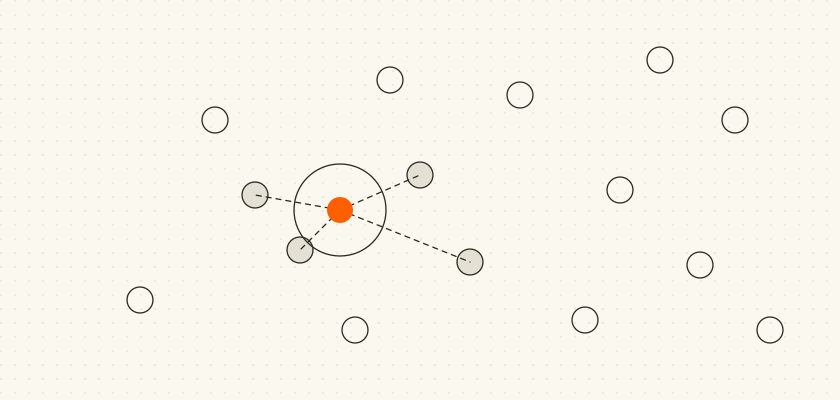
The engine behind all of this is the embedding. An embedding model reads a chunk of text and outputs a long list of numbers that captures its meaning. Two passages that mean similar things end up with similar numbers, so they sit close together in what people call vector space.
"Cancellation policy" and "how do I get a refund" are worded nothing alike, but a good embedding model places them near each other because they are about the same thing.
Once everything is a set of coordinates in that space, finding relevant information becomes a geometry problem: retrieve the items nearest to the query.
Doing that exactly across millions of records would be too slow, so vector databases use approximate nearest neighbour indexing to get almost the same answer far faster.
The dominant algorithm for this in 2026 is HNSW, which builds a layered graph of connections so a search can hop quickly to the right neighbourhood rather than scanning the whole set.
You do not need the maths; the practical takeaway is that this indexing is what keeps retrieval fast as your knowledge grows.
The honest caveat is that similarity search is only as good as the embeddings feeding it. Poor quality source documents, badly split text, or a weak embedding model will surface plausible but wrong matches, and no amount of database speed fixes that.
Retrieval quality is a content and setup problem first, and an infrastructure problem second.
Vector databases versus traditional databases
It helps to see the two side by side. A traditional database, the kind that already runs your CRM or accounts, excels at exact and structured queries: this customer ID, orders after this date, invoices above this value. Ask it for anything about meaning and it has nothing to offer.
A vector database excels at the opposite: fuzzy, meaning based questions where the exact words are unknown, but it is poor at the precise structured lookups a traditional database does effortlessly.
The important thing is that this is not a choice between them. Most real systems need both. And the current production standard is not pure vector search either.
Combining dense vector search with traditional keyword scoring, an approach usually called hybrid search, reliably outperforms either method on its own, because keywords catch exact terms like product codes and part numbers that meaning based search can blur.
A serious 2026 build almost always uses hybrid retrieval rather than vectors alone, and often adds a relevance reordering pass on top that re sorts the shortlisted results for accuracy before they reach the model.
If a proposal you are handed treats a vector database as the whole answer, that is a sign it is a year or two behind current practice.
Which vector database in 2026?
The market has narrowed. Despite dozens of products existing, four dominate serious production use in the middle of 2026, and you can brief sensibly knowing only these.
Pinecone is the managed option: someone else runs the infrastructure, it holds to a service agreement, and it returns results quickly at scale. It is the fastest route to a working system and the one that asks least of your own team, at the cost of an ongoing subscription.
Qdrant is the self hosted, cost efficient choice, favoured when volumes are large and you would rather run it on your own infrastructure than pay per query.
Weaviate is open source with hybrid search and multitenancy built in, useful when you need to keep different clients' or departments' data cleanly separated. And pgvector is an extension to PostgreSQL, the widely used open source database many businesses already run.
It is free, adds vector search to a system you likely already have, and needs no new infrastructure.
The practical selector is simpler than the product list suggests. If you are under roughly ten million vectors and already on Postgres, start with pgvector, because it costs nothing and adds no moving parts. Graduate to Qdrant or Pinecone only when throughput or latency genuinely demands it.
Most first automation projects never need to leave the starting option, and any partner who reaches for an expensive managed service on day one, before you have proven the workflow is worth automating at all, is spending your money too early.
Vector database use cases for businesses
The concrete uses are easier to picture than the technology. A knowledge assistant that answers staff or customer questions from your own policy and product documents needs a vector store to find the right passage before the AI writes its reply.
Semantic customer support search lets an agent type a problem in plain language and surface the closest matching past ticket or help article, rather than guessing keywords. Contract and document similarity search finds clauses or records that resemble a reference one, which is useful in legal, procurement, and compliance work.
Product recommendation matches items by similarity of description or behaviour rather than by tags alone.
In every one of these, the pattern is the same: the AI finds the right information in milliseconds, and the vector database is what makes that finding possible. It is the memory layer sitting behind the visible feature.
That is also why it rarely appears in a business case by name; what you are buying is the assistant or the search, and the vector database is plumbing that a competent build includes without you having to specify it.
How to choose and set up a vector database
You do not start by choosing a vector database. You start by deciding whether the work in front of you needs retrieval at all, and if it does, which knowledge it should draw on and how that knowledge is kept current.
The database is a downstream decision that follows from those answers, and picking it first is how projects end up paying for infrastructure that never earns its keep.
A sensible sequence is: identify the questions your team asks repeatedly and the documents that answer them, confirm those documents are accurate and reasonably well organised, then scope a small retrieval build against them before committing to any particular product.
Our guide to RAG covers how the retrieval and generation fit together, and our guide to AI knowledge bases covers getting the underlying content into shape, which is the step that most often decides whether the whole thing works.
For how an agent connects to your live systems once it can retrieve, our note on MCP explains the integration standard. For the finished result these parts add up to, our AI search for company documents puts retrieval to work over the files your team relies on.
Vector database questions, answered plainly
Sizing up whether a vector database earns its place
The single most useful thing to hold onto is that a vector database is a means, not an end.
It earns its place only when you have knowledge worth retrieving by meaning and enough of it to justify the setup, and for many businesses the free, Postgres native starting option covers that comfortably.
Which of your workflows, if any, actually needs retrieval, and at what scale, is a question about your specific documents and the work you want done, not about the products themselves.
An automation audit is how we answer it: we look at the questions your team asks over and over, judge whether a retrieval system would genuinely pay for itself, and design any build around the data and tools you already have.
When that becomes something to build, our workflow agents service is how we put it in place and keep it accurate over time.
For the wider picture, our RAG guide shows how retrieval and generation work together, and the original HNSW paper by Malkov and Yashunin sets out the indexing method behind most vector databases in full.