MCP explained: model context protocol
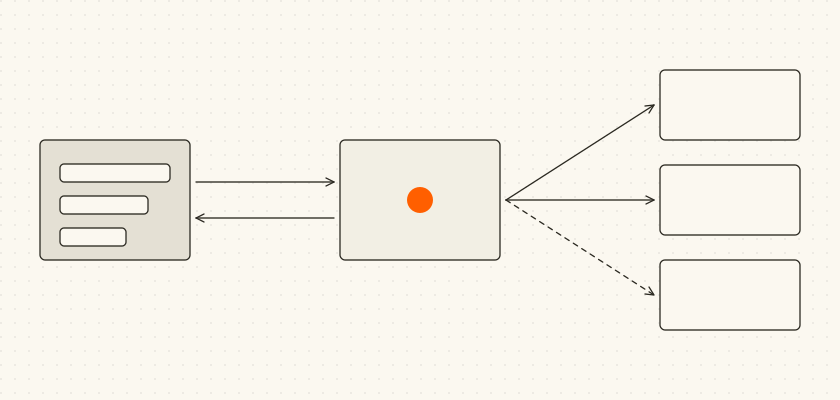
The Model Context Protocol, or MCP, is an open standard that gives an AI agent one consistent way to connect to your tools and data, so it can read from your CRM, check your calendar, query your documents or update your ticketing system without a custom piece of code written for every single connection.
The usual analogy is that MCP is a kind of USB port for AI: instead of a different cable for every device, one standard socket that everything plugs into.
It was introduced by Anthropic in late 2024 as an open standard, and in December 2025 its governance was handed to the newly formed Agentic AI Foundation under the Linux Foundation, co founded with OpenAI and Block, which is what turned it from one company's idea into a neutral industry standard the major AI platforms now support.
For the owner or operations lead of a smaller UK company who keeps seeing MCP mentioned when evaluating AI automation and wants to understand what it is and, more usefully, what it means for them as a buyer rather than a builder.
Almost every page that ranks for this term is written for developers building MCP connections or for product managers; none of them tells a business owner what to actually ask a vendor about it. This one does.
It is a spoke under our pillar on RAG, because both are about giving an AI system reliable access to your world.
Where this sits in our own work: our builds connect AI to the tools a business already uses, and MCP is one of the standards we build with.
So this page is honest about both what it unlocks and where its risks sit, because those risks are exactly the ones a buyer should be asking about.
What is the Model Context Protocol?
The Model Context Protocol is an open standard that gives AI agents a single, consistent way to connect to external tools, data sources and services, replacing the old requirement for a bespoke integration between every AI model and every tool. To see why that matters, picture the problem it solves.
If you have several AI applications and several tools you want them to reach, and every pairing needs its own custom connector, the number of connectors you have to build and maintain multiplies: a handful of models across a handful of tools quickly becomes dozens of brittle integrations.
This is often called the M by N problem, M models times N tools. MCP collapses it. Each tool exposes itself once, in the standard way, and each AI application speaks the standard once, so the total effort drops from a multiplying number to a simple sum.
That collapse, from many bespoke connectors to one shared standard, is the whole point of MCP.
How MCP works, hosts, clients, and servers
MCP has three parts, and the names are less important than the roles they play. Understanding them makes the vendor conversations much clearer.
The MCP host
The host is the AI application the work happens in, the assistant or agent your team actually uses. It manages the connections and decides which tools the agent is allowed to reach. In a business setting the host is whatever AI product or bespoke agent you are running.
The MCP client
The client is the standard speaking layer that sits inside the host. It is the part that knows how to talk the protocol, so the host does not have to reinvent that for every tool.
You will rarely think about it directly; it is the plumbing that makes the standard work.
The MCP server
The server is a small service that exposes one tool or data source in the standard way, your CRM, your calendar, your document store. Each system you want the agent to reach gets a server, and once it exists, any MCP speaking agent can use it. This is where the reusability comes from.
In practice the flow is simple to picture.
Your agent needs a customer's record, so it asks the CRM's MCP server for it; the server fetches the record and hands it back in the standard format; the agent uses it in whatever it is doing, perhaps drafting a reply or updating a deal.
The same pattern works for booking a calendar slot, looking something up in your knowledge base, or posting a message, each through its own server, all spoken in one language.
MCP vs API, what is the difference?
A fair question, since businesses already hear plenty about APIs. An API is the way one specific piece of software lets others talk to it, and every API is different, so connecting an AI model to ten tools has historically meant learning and maintaining ten different APIs.
MCP sits a level above that: it is a single standard way for an AI agent to use tools, so the agent learns one protocol rather than ten interfaces.
Under the surface an MCP server often still calls the underlying tool's API; what MCP adds is a consistent, agent friendly layer over the top, so the AI side does not carry the cost of every tool's quirks.
Put simply, APIs connect software to software in their own individual ways, and MCP gives AI agents one common way to use all of them.
MCP adoption in 2026, where it stands
MCP has moved from announcement to genuine ecosystem remarkably fast.
Within about a year of launch it had reached tens of millions of monthly downloads of its developer kits and thousands of active public servers, and first class support across the major AI platforms including the products from Anthropic, OpenAI, Google and Microsoft.
The transfer to independent governance under the Linux Foundation in December 2025 matters here too, because it signals that the standard is not controlled by any single vendor, which is exactly what makes a business willing to build on it.
The honest counterpoint belongs in the same breath. A standard growing this fast has grown faster than its security practices, and that is a real consideration for a buyer.
A meaningful share of the public MCP servers that have appeared use weak or no authentication, and a run of security vulnerabilities has been reported as the ecosystem has expanded. None of this makes MCP unusable; it makes governance the thing that matters.
MCP is production ready in careful, well governed deployments, and it is not yet a zero risk, plug and play standard you should adopt without asking how each connection is secured. That distinction is precisely what a business should be probing when a vendor offers MCP based integration.
MCP use cases for businesses
For a business, the value of MCP is not abstract; it is the difference between an AI agent that can only talk and one that can actually do things in your systems.
A sales agent connected through MCP can read a lead from your CRM, check your calendar, and book a call, all through standard connections rather than three separate custom builds. A support agent can pull the relevant record, look up the answer in your knowledge base, and log the outcome.
An internal assistant can query your documents and update a shared system when something changes. The common thread is that MCP is what lets an agent reach across your tools consistently and, done properly, securely, which is the capability that turns a chatbot into something that touches real work.
Where those agents also need to reason over your documents, that pairs with the retrieval approach covered in our guide to RAG, and the storage behind it in our guide to vector databases.
How to adopt MCP without rebuilding everything
For a business buying rather than building, getting started with MCP is less about the technology and more about the questions you ask. When you commission AI automation, ask whether the integrations are MCP compatible, because that affects how easily the system can be extended and maintained later.
Ask how each connection is authenticated and what the audit trail looks like, since that is where the ecosystem's real risk sits. And ask whether you actually need the breadth MCP offers, because a single, bounded automation touching one system may not need a general standard at all.
The sensible path is the same as with any automation: start with one workflow that genuinely needs the agent to reach into a system, make sure that one connection is secure and reliable, and expand only as the value proves out.
What the agent itself is and how it behaves is covered in our pillar guide to AI agents. When the aim is simply to get an agent reaching reliably into the tools you already run, that is our work on connecting disconnected systems.
MCP questions answered in plain English
Where MCP fits in your own AI setup
The useful takeaway is that MCP is the standard that lets an AI agent reach into your actual systems, and the thing a buyer should care about is not the protocol itself but how any given connection is secured and governed.
Whether your situation even needs a general standard, or a single well built connection would do, is a question about your specific systems and the work you want automated.
An automation audit is how we sort that out: we look at what an agent would genuinely need to touch to be useful to you, judge whether standardised integration earns its place, and design any build securely around the tools you already run.
If that turns into a build, our workflow agents service is where we stand it up and keep it running safely.
For the pillar context, our guide to RAG covers grounding an agent in your documents, and the official protocol home at modelcontextprotocol.io sets out the standard in full.